Country and language selection
Your country: Ireland
Your language: English
Do you want to switch to your country version? Welcome to ZIEHL-ABEGG!
You are visiting our Website from Greece?

On the website for your region you will find information on the products relevant to you, contact details and news.

Unfortunately, there is no Greek language version of our website. However, you can stay on this page or contact our sales representative in Greece directly.

Vibration | Mechanical Oscillations

in fan technology

What is vibration, or mechanical oscillation?

“Mechanical vibration” describes a time-varying motion of a mechanical system around a point of equilibrium or a state of rest, resulting from the interaction of mass (inertia) and restoring forces. This motion can be periodic or quasi-periodic.

Vibration is defined in ISO 2041:2018 as “mechanical oscillation of a body about a position of equilibrium.” In the practical context of mechanical and plant engineering, the term often refers to an undesirable, negatively assessed form of mechanical oscillation that can stress components, cause noise, or even impair the system’s operation.

Example: Why does the washing machine “bounce” during the spin cycle?

What is the difference between vibration, oscillation, and mechanical oscillation?

The terms “vibration,” “mechanical oscillation,” and “oscillation" all describe the same fundamental physical principle: a time-varying motion or state change about an equilibrium position.
The difference lies primarily in their scope and typical field of application, and context rather than in the underlying physics:

  • “Vibration” refers to the mechanical oscillatory motion of a body or structure. In engineering practice - particularly in machinery, rotating equipment, and structural dynamics - it is the standard term used for vibration measurement, monitoring, diagnostics, and compliance with industry standards. The term is generally value-neutral and does not inherently imply an unwanted or harmful condition.
  • “Mechanical oscillation” is the more general scientific term for the oscillatory motion of a mechanical system about an equilibrium position. It is commonly used in physics and engineering when describing the underlying dynamics and mathematical behavior of mechanical systems.
  • “Oscillation” is the broadest term, referring to periodic or quasi-periodic variations in the state of any systems. It applies not only to mechanical systems but also to electrical, thermal, chemical, biological, and many other physical processes.

Key Physical Parameters

Ampitude

The amplitude A quantifies the strength of a vibration and thus the maximum deflection of a system from its equilibrium position. It is of central importance in the assessment of vibration-induced stress and wear. The amplitude is directly related to the vibrational energy stored in the system. As the energy increases, so does the amplitude of the vibration.

Frequency

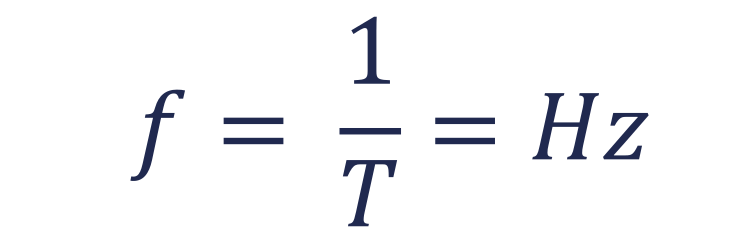
The frequency f indicates how many oscillations occur per unit of time and is expressed in hertz (Hz). It is defined as the reciprocal of the period T. It is one of the key parameters in vibration analysis, since many technical causes generate characteristic frequencies.

As a general rule:

  • High frequency: Many oscillations per unit of time and a short period
  • Low frequency: Few oscillations per unit of time and a long period

Period Length

The period T is the time required for one complete oscillation. It is calculated from the wavelength λ and the wave velocity v, and is therefore directly related to the frequency.

The period T is measured in seconds (s).

Phase

The phase φ describes the timing of an oscillation relative to a reference time. It is particularly relevant in analysis when comparing multiple oscillations.

Basic Types of Vibrations

Mechanical vibrations can be classified according to various criteria. For understanding technical applications, the distinction based on the type of excitation, damping, and cause is particularly relevant.

Classification by Type of Stimulation

  • Free vibrations occur when a system is displaced from its equilibrium position and oscillates without external influence. The motion occurs at the system’s natural frequency and decreases over time due to damping.
  • Forced vibrations are caused by continuous external excitation. In a steady state, the vibration frequency corresponds to the excitation frequency. The amplitude is influenced by the strength of the excitation, the system damping, and the proximity to the natural frequency.

Classification by Damping

  • Undamped vibrations describe an ideal model with constant amplitude and no energy losses. Since such vibrations do not occur in real-world applications, they are of purely theoretical relevance.
  • Damped vibrations have a steadily decreasing amplitude without continuous external excitation. Since energy losses always occur in real-world applications—for example, due to friction—mechanical vibrations are always damped in practice.

Classification by Cause

  • Structural vibrations arise from the dynamic properties of the system, particularly its mass, stiffness, and boundary conditions.
  • Rotordynamic vibrations occur in rotating systems. They are caused, for example, by unbalanced masses, deformations, or bearing forces.
  • Flow-induced vibrations arise from transient forces, such as turbulence, generated by the conveyed medium (e.g., air).

In fan engineering, mechanical vibrations resulting from mechanical motion predominantly occur as forced, damped vibrations. Excitation typically arises from a combination of rotor-dynamic causes (e.g., imbalance) and flow-related factors (e.g., turbulence). The interaction of the excitation with the structural properties of the system determines the resulting vibration behavior.

Natural Frequency & Resonance

Natural Frequency

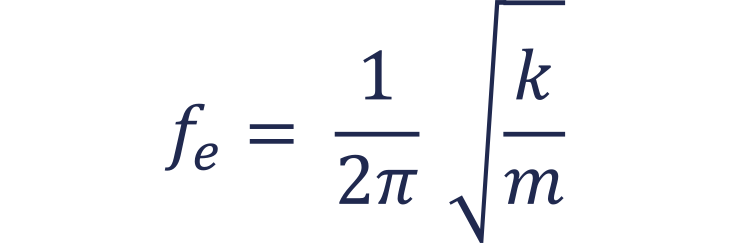
The natural frequency is a system-specific physical quantity that describes the frequency at which a mechanical system oscillates freely after a single excitation. It is determined solely by the physical properties of a system, in particular its mass and stiffness. For a simple linear system, the natural frequency fe is given by the ratio of stiffness k to mass m:

As a general rule:

  • High stiffness results in high natural frequencies
  • High mass results in low natural frequencies

Real-world systems can have multiple natural frequencies simultaneously, which depend on their geometry and boundary conditions. Each of these natural frequencies is associated with a characteristic vibration pattern (mode).

This mode describes the spatial motion and deformation pattern of the system during vibration. Depending on the mode shape, deflections of varying magnitudes occur at different locations within the system. As a result, certain areas of a component may be subjected to particularly high stresses, while others remain virtually motionless.

Resonance

Resonance is a physical phenomenon that occurs when the frequency of an external excitation approaches the natural frequency of a system:

fexitation ≈ fe

In this case, the energy supplied to the system is particularly efficient, which can cause the vibration amplitude to increase significantly.

In rotating machinery, the excitation frequencies are often directly related to the rotational speed. Critical speeds refer to those speed ranges in which resonance can occur. In these ranges, increased vibration amplitudes can occur, which can lead to increased wear, noise, or damage to components.

How do vibrations occur?

Vibrations, or mechanical oscillations, occur when a system is displaced from its equilibrium position and restoring forces act upon it, which, together with inertia, cause a time-varying motion.

The vibrational behavior of a system is largely determined by the interaction of the following physical properties

  • Mass (inertia)
  • Stiffness (elastic restoring forces)
  • Damping (energy losses)

In addition, the actual vibration behavior is determined by external factors, in particular by:

  • Excitation (e.g., frequency and direction of excitation)
  • Boundary conditions (mounting, fastening, and force transmission due to the installation configuration)

In technical applications, vibrations are primarily caused by external or internal excitations that affect the system during operation.

What are the effects of vibrations?

Vibrations affect technical systems in various ways and can influence the function, service life, and safety of machines. The effects depend largely on the amplitude, frequency, and duration of the vibration excitation.

Mechanical Stress and Material Fatigue

Vibrations cause time-varying stresses in components. Over time, these dynamic loads can lead to material fatigue, even if the stresses that occur are below the static strength.

Typical consequences include:

  • Cracking in high-stress areas
  • Fatigue fractures in shafts, housings, or fasteners
  • Loosening of bolted joints

Bearing Load and Wear

In rotating machines, vibrations act directly on the bearings. This generates additional contact forces that can lead to increased wear.

Possible effects:

  • Increased bearing temperature and premature wear
  • Disruption of the lubricating film
  • Increased noise due to rough running

Noise Level

Vibrations are a major cause of increased noise in machines. Vibrating components transfer energy to their surroundings, resulting in audible sound.

Possible consequences:

  • Increased noise levels during operation
  • Structural humming or whistling noises
  • For ventilation systems: Undesirable resonance effects in the air duct

Impaired Function and Loss of Efficiency

Severe vibrations can compromise the operational stability of a system. In fans, this can lead in particular to the following effects:

  • Imbalance in the impeller
  • Reduced efficiency due to increased energy losses
  • Disturbed flow conditions
  • Reduced control accuracy of the system

These effects can reinforce one another and lead to overall unstable operating behavior.
 

Comfort and Environmental Effects

In addition to technical impacts, vibrations can also lead to perceptible effects:

  • Transmission of vibrations to the surrounding area (e.g., mounting surface, building structure)
  • Disturbance caused by noticeable vibrations
  • Disturbance caused by increased noise levels

Safety and Damage Risks

Particularly severe or prolonged vibrations can lead to critical operating conditions:

  • Structural failure of components
  • Uncontrolled machine behavior
  • Equipment failure

Vibration in Fan Technology

In fan technology, vibration behavior depends not only on the fan type, but also significantly on the installation configuration and operating conditions.

  • Due to their design and the often higher mass of the impeller, centrifugal fans are prone to potentially stronger rotor-dynamic excitations. In particular, when mounted directly on flexible structures, such as walls or housings, this can lead to increased vibration transmission.
  • Axial fans, on the other hand, often exhibit smoother operation but are more susceptible to flow-induced vibrations.

The factors described not only determine the magnitude of the vibrations that occur but also their mode of motion. In practice, these vibrations manifest as characteristic motion patterns known as modes.

Vibration Measurement, Analysis, and Monitoring

Vibration Measurement

When measuring vibrations, the displacement, vibration velocity, and vibration acceleration of a vibrating system are recorded in particular. These physical quantities enable a quantitative description of the vibration behavior.
For data acquisition, sensors are typically mounted at vibration-relevant locations, such as integrated 3-axis sensors in the engine electronics.

Analysis of Vibration Data

The analysis of vibration data is used to identify the causes of vibrations, evaluate operating conditions, and detect critical changes at an early stage. To this end, measurement data is analyzed and visualized using software.
Advanced software-based analysis systems enable the automated analysis of large amounts of data as well as the reproducible evaluation of complex vibration systems.

Vibration Monitoring

Continuous vibration monitoring enables the early detection of changes in operational behavior and forms the basis for condition-based maintenance (condition monitoring).
By the ongoing collection and analysis of vibration data, critical changes in operational behavior can be detected early, and potential damage can be predicted even before critical operating conditions arise.

Special Features of Fan Arrays

In the case of fan arrays (fan walls), the vibration behavior must also be considered as an overall system. Compared to individually operated fans, the vibrations of multiple fans can influence one another.

These interactions arise in particular through shared support structures, housings, or flow-induced couplings. As a result, vibrations can be locally amplified, superimposed, or transmitted to other components.

If multiple fans are operated at similar but not exactly identical rotational speeds, beat phenomena may also occur. This results in periodic amplifications and attenuations of the vibration amplitudes.

Furthermore, the entire fan array has its own structural natural frequencies and modes. If these are excited simultaneously by multiple fans, increased dynamic loads can arise within the overall system.

Therefore, for analysis and monitoring, it is not only the evaluation of individual fans that is relevant, but also the dynamic behavior of the entire system. Advanced monitoring systems enable the synchronous acquisition and analysis of multiple fans within a single system.

To reduce critical vibrations, measures such as vibration isolators and the targeted avoidance of critical resonance ranges within the operating range are employed.

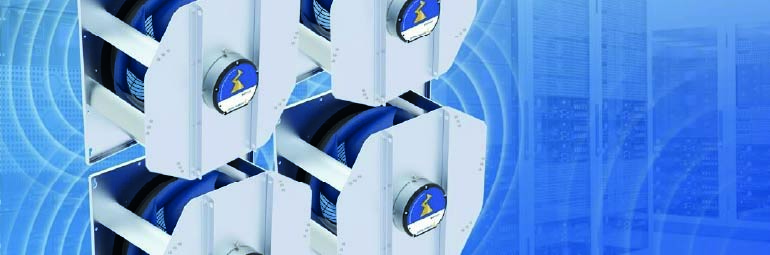
Automated Vibration Measurement & Vibration Analysis for Fans - With ZAset Vibration Client

Vibration Reduction

In practice, vibration problems often do not occur in isolation but result from the interaction of several causes. Vibrations can be reduced through design, rotor dynamics, structural, or control measures.
The following selection of measures can help minimize vibration excitation, prevent resonance, and limit the transmission of vibrations to the surrounding environment:

Reduction of Imbalances

Imbalances are common causes of mechanical vibrations in rotating machines:

  • Precise rotor balancing
  • Even mass distribution
  • Prevention of contamination on the impeller

Follow the manufacturer's installation recommendations

The installation configuration has a significant impact on the vibration behavior of fans. Unfavorable flow conditions or improper installation conditions can cause additional vibration excitation. Examples:

  • Insufficient clearance from walls or obstacles
  • Uneven airflow
  • Turbulence
  • Unfavorable duct or housing geometries

The manufacturer’s installation recommendations should therefore be followed during installation to ensure stable operation of the entire system.

For optimal performance and service life: Installation and operating instructions for ZIEHL-ABEGG centrifugal fans

Avoiding Critical Resonance Ranges

Resonances can lead to significantly increased vibration amplitudes:

  • Adjusting stiffness or mass
  • Changing natural frequencies
  • Avoiding critical speed ranges
  • Blocking critical speed ranges in the control system

Optimization and Reinforcement of Structural Frames

The stiffness of the support structure has a significant influence on the dynamic behavior of a fan system. Flexible or inadequately designed structures can lead to increased vibration amplitudes and resonance effects.

By making design adjustments such as additional bracing, stiffer mountings, or optimized structural geometry, natural frequencies can be specifically adjusted to avoid critical resonance ranges.

Particularly in the case of fan arrays and wall-mounted fans, the structural design of the entire system plays an important role in its vibration behavior.

Vibration Isolation and Damping

The transmission of vibrations to adjacent components or building structures can be reduced through appropriate decoupling measures:

  • Use of vibration isolators or dampers
  • Elastic mounting
  • Optimization of force transmission to the surrounding environment

Flow Optimization

Flow-induced vibrations can be reduced by ensuring stable and uniform flow conditions:

  • Optimized impeller geometries
  • Prevention of flow separation
  • Reduction of turbulence
  • Optimized inflow and outflow conditions

Condition Monitoring and Predictive Maintenance

Continuous monitoring of vibration data enables the early detection of critical changes in operational behavior.

Advanced monitoring and analysis systems form an important foundation for condition-based maintenance strategies, including predictive maintenance.

Was this page helpful?