Country and language selection
Your country: Singapore
Your language: English
Do you want to switch to your country version? Welcome to ZIEHL-ABEGG!
You are visiting our Website from Greece?

On the website for your region you will find information on the products relevant to you, contact details and news.

Unfortunately, there is no Greek language version of our website. However, you can stay on this page or contact our sales representative in Greece directly.

Acoustics definition

Acoustics generally refers to the scientific study of sound, its origin, propagation, perception, and effects. Among other things, acoustics is used to investigate and reduce noise. A basic prerequisite for the propagation of sound is the presence of matter, i.e., a gaseous, liquid, or solid medium that carries the sound waves. The nature of the carrier medium has a significant influence on the speed at which sound propagates, known as the speed of sound.

If the sound is generated aerodynamically, i.e., by the movement of air molecules, this is referred to as aeroacoustics.

 Did you know: What is the speed of sound?

Fundamentals of Aeroacoustics

Noise is not only unpleasant to perceive, but in extreme cases can also have a serious impact on health. Sound pressure, sound power, and frequency are three physical quantities that can be used to quantify noise levels.

Sound pressure

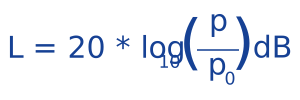
Sound pressure refers to pressure fluctuations caused by sound waves in a solid, liquid, or gaseous medium. Sound pressure is measured as a force acting perpendicular to a surface in pascals (Pa). gemessen. The sound pressure level is influenced by the distance between the sound source and the receiver, as well as any obstacles, e.g., in a room, and is therefore a location-dependent variable.
The human hearing threshold is approximately 0.00002 Pa, and the pain threshold (depending on personal sensitivity to noise) is approximately 20 Pa. To simplify this wide range, the sound pressure level is expressed on a logarithmic scale and quantified in decibels (dB).

Sound power

Sound power (= source strength) refers to the energy emitted by a sound source per unit of time and is therefore a location-independent variable. Sound pressure thus forms the basis for calculating sound power and enables an objective comparison of different sound sources regardless of the ambient conditions. Sound power is calculated by integrating the sound pressure and is expressed in watts (W).

Similar to the sound pressure level p, the sound power level P is also expressed on a logarithmic scale and specified in decibels (dB).

Sound pressure formula
Sound power formula

Frequency

Frequency is a measure of the number of periodic events (e.g., sound wave vibrations) that repeat themselves in a given unit of time. In acoustics, frequency indicates how often a sound signal vibrates within one second, or how many repetitions of a continuous vibration follow one another within one second. Frequency is measured in hertz (Hz), with 1 hertz corresponding to one oscillation per second.
The frequency range audible to humans is between 16 and 20,000 Hz (20 kHz).

Due to the fact that human hearing perceives sounds of equal sound pressure but different frequencies as having different volumes, the frequency spectrum of a sound source is evaluated.
This evaluation is performed using three different filters, which are defined from A (below 55 dB) to C (above 85 dB). The sound power level, taking into account the A filter, is often used in connection with ventilation systems and the corresponding numerical value is given in dB(A).

To summarise, sound is a subjective sensory variable characterized by one or more frequencies with corresponding amplitudes and quantified by an evaluation adapted to humans.

Measurement methods for fan aeroacoustics

In addition to air flow and electrical data, the acoustics of ventilation products are also carefully tested and are subject to standards and norms. Measurements are usually carried out in an anechoic chamber test bench, in a test duct, or as a free-field measurement. The number and positioning of microphones is specified by relevant standards.

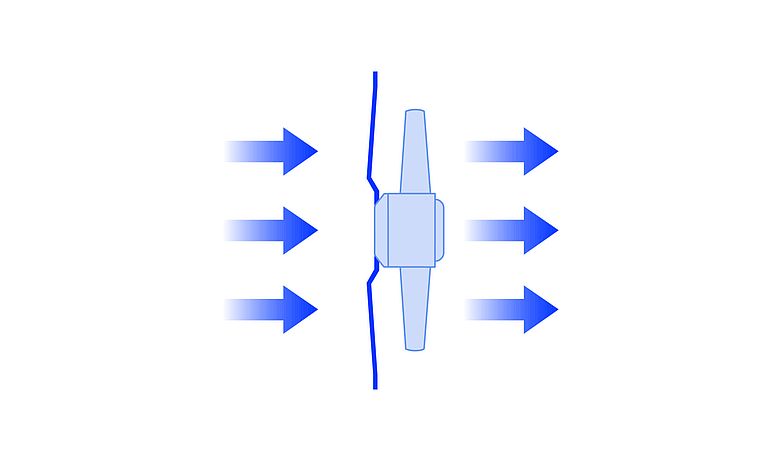
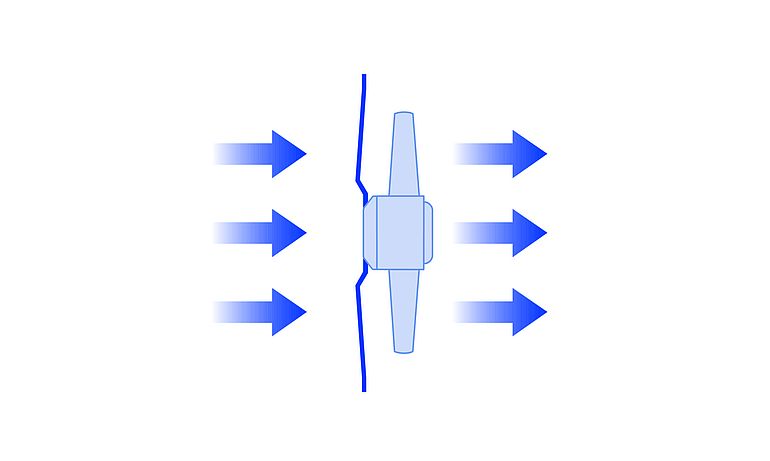
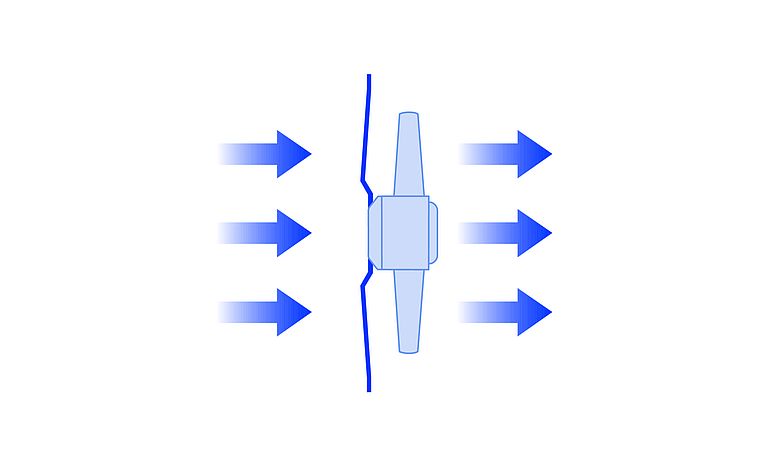
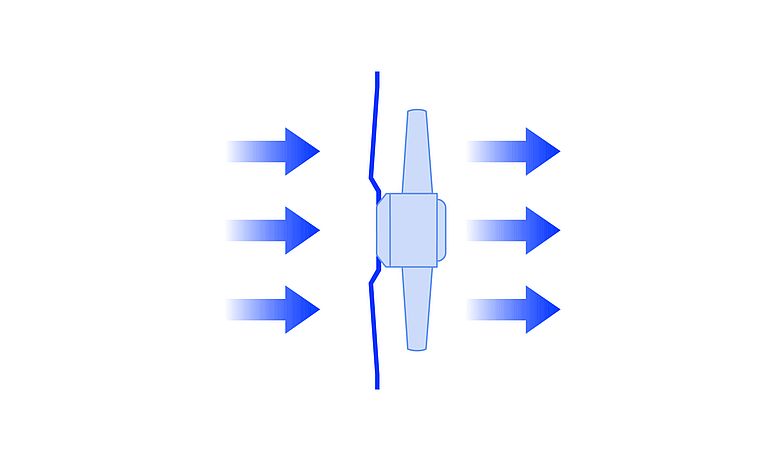
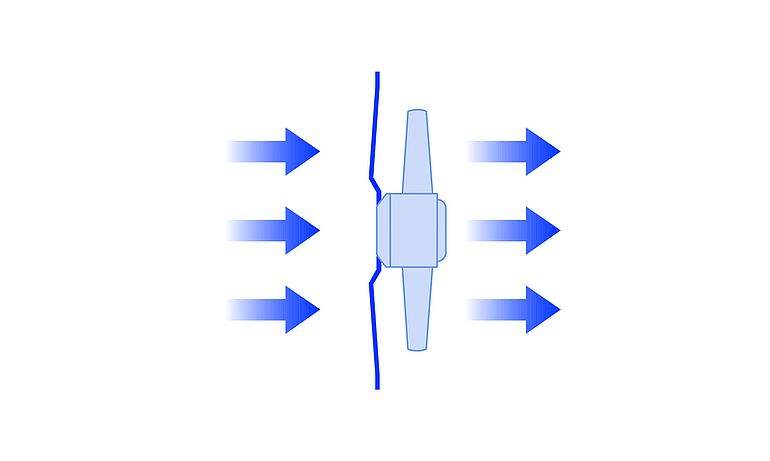
The fan to be tested (test specimen) can be tested in different installation types or in different measurement categories (see ISO 13349):

  • Installation type A: Free suction and free blow-off
  • Installation type B: Free suction and pipe-guided blow-off
  • Installation type C: Pipe-guided suction and free blow-off
  • Installation type D: Pipe-guided suction and pipe-guided blow-off
  • Installation type E: Free suction and free blow-off without partition wall

Tested innovation: ZIEHL-ABEGG's InVent development center has the largest and most modern combination test bench in the world!

Standards & Norms

Measurement methods for the acoustic evaluation of fans are regulated by the International Organization for Standardization (ISO) in specific norms and standards to enable comparability and reproducibility:

  • DIN EN ISO 3745 contains provisions for sound power and sound energy levels of noise sources based on sound pressure measurements.
  • DIN ISO 5801 regulates the performance measurement of fans on standardized test benches, e.g., by minimum geometric dimensions, volume flow, static pressure, etc.
  • DIN ISO 13347-3 contains provisions for sound power levels under standardized laboratory conditions for industrial fans.
  • AMCA 210 is, alongside ISO 5801, a globally recognized standard for the construction of fan test benches, defined by the Air Movement and Control Association International, Inc. (AMCA).

Noise generation in the ventilation system

A ventilation system consists of various components and therefore contains different sound sources that generate different types of noise (examples):

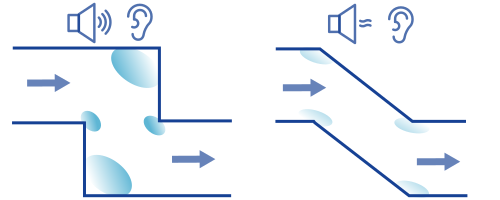
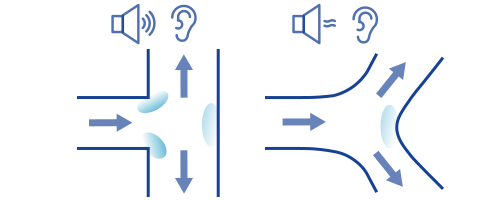
  • Aerodynamic noise: The fan accelerates the air, thereby generating an increase in pressure or a volume flow, which causes turbulence and eddies to form at the leading and trailing edges, for example. Friction effects and pressure differences in highly branched air ducts, edges at connection points, filters, throttle valves, flow noises at the air outlets, or other factors can cause aerodynamic noise to be transmitted throughout the entire system, making it the dominant type of noise in a ventilation system.
  • Mechanical noise can be caused by moving parts such as bearings, running noise from the electric motor, or vibrations. In terms of overall perception, mechanical noise tends to be of secondary importance.
  • Structure-borne noise is caused by the transmission of vibrations to the building structure, which can lead to resonance.
  • Electrical noise can be caused, for example, by the control system, electronic components, or magnets in electric motors, but is hardly noticeable in the overall noise level of a ventilation system.
  • Noise caused by air leakage can be caused, for example, by leaky connections in the air duct or damage to the duct walls. In addition to the negative effects on acoustics, this also results in losses in the system efficiency of the plant.
Geräuschentwicklung in einem Lüftungssystem (Beispiele)

Aerodynamic noise caused by turbulence and swirling air is the dominant type of noise in a ventilation system.

Impellers can be optimized for efficiency and acoustics

Additional components (e.g., filters) can become clogged and should be checked regularly.

Flaps on the air inlets and outlets can cause mechanical noise and/or flow noise.

What makes a fan quiet?

  • Optimized design of the blade geometry has a significant influence on the noise emission of the impeller. Through targeted design of the blades, the flow can be improved and thus noise emission minimized. Computational fluid dynamics (CFD), a numerical flow simulation, enables detailed analysis and optimization of flow characteristics, allowing potentially critical noise sources to be identified and eliminated at an early stage.
  • Optimal dimensioning and design of the system improve acoustics: The peripheral speed of the impeller influences the sound power level during operation. To generate a dedicated volume flow, a large impeller operates more quietly than a smaller one with a comparable blade geometry.
  • Bionics offers innovative solutions for optimizing the aerodynamics and aeroacoustics of fans. This can lead to a significant improvement in efficiency and a significant reduction in noise emissions.
  • Additional components, such as guide vanes or deflector grilles, align the flow and thus reduce turbulence or swirls, which significantly reduces aerodynamic noise.

Improved acoustics in confined installation conditions: ZAflow from ZIEHL-ABEGG

Influence of installation situation

The installation conditions of a ventilation system have a significant impact on its efficiency and noise levels. Examples of important influencing factors include

  • Space conditions: Cramped installation situations or insufficient distances to walls or other obstacles can cause unwanted turbulence, which reflects sound waves and thus increases the overall sound level of the system. To prevent this, the system must be configured, designed, and dimensioned as optimally as possible with regard to the installation conditions and requirements of the application.
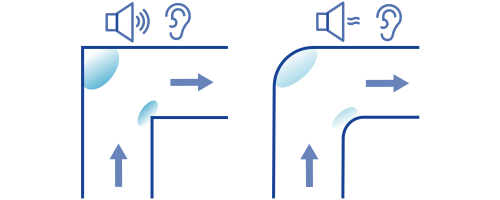
  • Duct system: Round air ducts and connectors generate less turbulence and pressure loss and thus less noise than square ones, but cannot be used in every installation situation. Deflections and branches in the duct also affect the flow behavior and aeroacoustics. An additional negative influencing factor is the accumulation of dust or contamination on filters, duct walls, or other surfaces in the system.
  • Additional components, such as clogged filters, poorly positioned dampers, seals, or dampers, can negatively affect the flow profile and may lead to higher power requirements for the fan.
  • Room acoustics: Hard, sound-reflecting surfaces in the room reflect the sound waves from the system, thereby increasing the sound pressure level and the perceived volume in the room.

Influence of the operating point

The operating point of an air handling system has a direct influence on its noise emission. A technically qualified and precise design can significantly reduce the noise level during operation.

  • Volume flow, pressures, flow velocity: High volume flows with small pipe diameters result in higher flow velocities according to the continuity equation. Higher air velocities usually cause higher aeroacoustic noise. In certain applications, e.g., industrial extraction systems, high air velocities or pressures are required to fulfill the purpose of the system or to prevent deposits in the system.
  • Speed: Impellers that are too small for the application or not optimally configured require higher speeds than larger impellers to generate the same required volume flow. The increased speed range can have a negative impact on the system efficiency of the plant and its noise level. Larger impellers generate the same volume flow at a lower sound power level than smaller impellers with comparable blade geometry due to the fact that they require a lower speed.
  • Control technology: If the fan is operated in conjunction with a frequency converter, incorrect settings or faulty coordination can cause additional noise due to electromagnetic interference or vibrations.

Example: Characteristic curve ZAbluefin RH50I-ZID.GG.CR

Acoustics intake side

Acoustics Pressure side

Sound insulation & sound attenuation

In addition to the design measures directly on the fan (primary measures), depending on the installation situation, application requirements, and cost situation, further secondary measures such as sound insulation or sound attenuation can be taken to reduce the noise pollution caused by an air handling system.

Sound insulation

Sound insulation prevents or reduces the propagation or transmission of sound, e.g. through certain housing materials, wall thicknesses, or the installation of vibration dampers.

Sound attenuation

Sound attenuation refers to the conversion of the energy of sound waves in the form of vibrations into another form of energy. Sound attenuators can be used in various types or designs. For example, absorption sound attenuators can absorb sound energy and convert it into heat through the use of porous or fibrous materials.

Was this page helpful?