Country and language selection
Your country: India
Your language: English
Do you want to switch to your country version? Welcome to ZIEHL-ABEGG!
You are visiting our Website from Greece?

On the website for your region you will find information on the products relevant to you, contact details and news.

Unfortunately, there is no Greek language version of our website. However, you can stay on this page or contact our sales representative in Greece directly.

What is a crossflow fan?

A crossflow fan (also referred to as a crossflow ventilator or tangential fan) is a special type of fan that draws in air or other gaseous media in a tangential direction to the drive axle of the impeller and discharges it again over a large area, also tangentially .
The rotation of the impeller fitted with forward-curved blades sets the air in motion using aerodynamic forces. Since crossflow fans convey large air volumes over a wide outlet surface, they are used, for example, to generate air curtains.

 Highest possible efficiency in numerous applications: Crossflow fans from ZIEHL-ABEGG

How does a crossflow fan work?

Crossflow fans belong to the group of centrifugal fans in terms of their design, but form a separate construction type due to their special flow behaviour. 

With crossflow fans, the air is sucked in over the entire width of the impeller, swirled and accelerated inside the impeller and then discharged again over the entire width of the impeller. The electric motor for driving the crossflow impeller is located outside the air flow.
Due to the nature of the housing, the air flowing out on the pressure side is deflected by 90° or 180° according to the application requirements and installation situation. The housing itself or additional components, such as baffles, enable high precision air guiding. 

How are crossflow fans constructed?

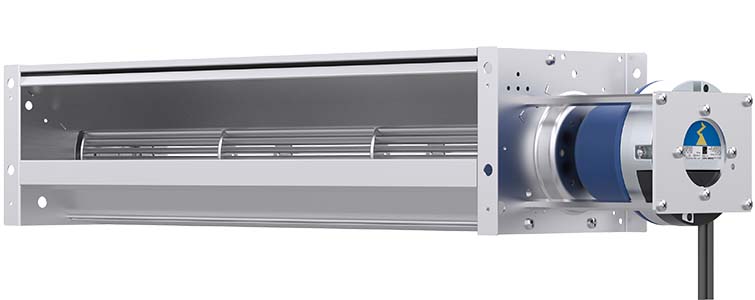
In terms of the basic design, crossflow fans typically consist of an impeller, an electric motor and a housing with suspension.

  • Impeller: When it comes to their appearance, crossflow impellers (also known as drums) resemble very elongated radial impellers. The impeller's relatively flat, forward-curved blades allow for a compact design or space-saving installation.
  • Motor: On a crossflow fan, the drive motor is usually mounted at the end of the drum, outside the air flow, and connected to the impeller via an engineered shaft. In principle, crossflow fans can be operated with different drive concepts. Depending on the application requirements, energy-saving EC motors or robust AC motors are usually used.
  • Housing: The housing is of central importance for how the air is guided in a crossflow fan. From the intake side, the air is directed into the swirl zones, accelerated and deflected. The nature of the air outlet on the pressure side allows for even air movement over a large area.

 Maximum efficiency: Crossflow fans with ECblue high-efficiency motor from ZIEHL-ABEGG

Drive motor with shaft

Impeller (drum) with forward-curved blades

Housing with suspension

What are the advantages of crossflow fans?

  • Compact design: The small footprint allows for flexible installation situations thanks to 90° or 180° air deflection
  • High-precision air guiding: The air outlet on crossflow fans allows for very targeted air guiding for numerous applications.
  • Quiet running properties for low noise generation: The impeller configuration with a large number of blades and the precise air guiding ensured by the housing facilitate very quiet, speed-reduced operation, e.g. in fan convectors.
  • Energy-saving operation: Crossflow fans are particularly economical in terms of current consumption and keep operating costs low when combined with EC motors.
  • High air flow: Due to their design, crossflow fans enable uniform air delivery over a wide outlet surface at relatively low static pressure.

Where are crossflow fans used?

Typical areas of application for crossflow fans are, for example:

“Crossflow fan” or “Cross-flow ventilator”?

In addition to the typical term "crossflow fan", other terms such as “crossflow ventilator”, “crossflow blower” or “tangential fan” are also used in day-to-day language. The different terms are used very differently in practice. From a technical point of view, "crossflow fan” is a synonym for "crossflow ventilator”.

Was this page helpful?