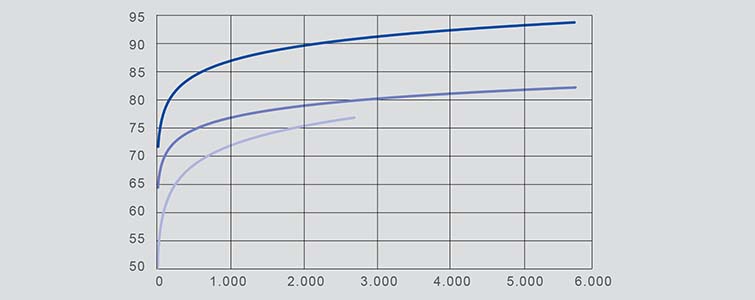
Efficiency describes the ratio of the converted, usable energy or power to the energy or power used. Energy efficiency is therefore a quantification of energy efficiency.
Efficiency is generally indicated by the Greek letter η (eta) and is usually specified as a decimal value or in percent. Since the converted energy is always lower than the supplied energy due to the resulting power losses, efficiency is always less than 1 or 100%.
Example: An electric motor that generates a mechanical power of 0.95 kW from a supplied electrical power of 1 kW has an efficiency of 0.95 or 95%. Consequently, 95% of the supplied electrical power is converted into mechanical power (torque). The remaining 5% represents the power loss caused by heat, for example.
Efficiency levels can also be determined for complex systems consisting of several different components. Looking at all components as a whole, we refer to system efficiency.
Maximum efficiency from ZIEHL-ABEGG: EC motors for fans and elevator drives from ZIEHL-ABEGG impress with particularly high efficiency!