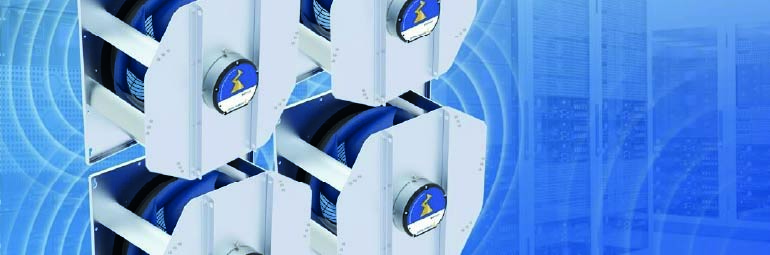
In the case of fan arrays (fan walls), the vibration behavior must also be considered as an overall system. Compared to individually operated fans, the vibrations of multiple fans can influence one another.
These interactions arise in particular through shared support structures, housings, or flow-induced couplings. As a result, vibrations can be locally amplified, superimposed, or transmitted to other components.
If multiple fans are operated at similar but not exactly identical rotational speeds, beat phenomena may also occur. This results in periodic amplifications and attenuations of the vibration amplitudes.
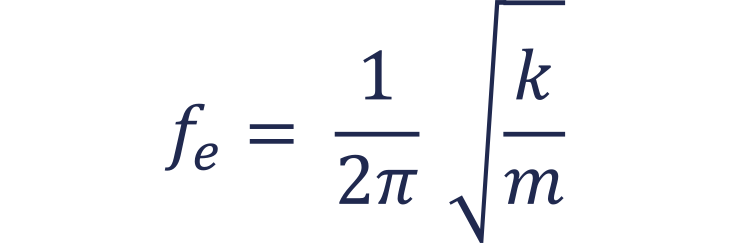
Furthermore, the entire fan array has its own structural natural frequencies and modes. If these are excited simultaneously by multiple fans, increased dynamic loads can arise within the overall system.
Therefore, for analysis and monitoring, it is not only the evaluation of individual fans that is relevant, but also the dynamic behavior of the entire system. Advanced monitoring systems enable the synchronous acquisition and analysis of multiple fans within a single system.
To reduce critical vibrations, measures such as vibration isolators and the targeted avoidance of critical resonance ranges within the operating range are employed.