Country and language selection
Your country: United Kingdom
Your language: English
Do you want to switch to your country version? Welcome to ZIEHL-ABEGG!
You are visiting our Website from Greece?

On the website for your region you will find information on the products relevant to you, contact details and news.

Unfortunately, there is no Greek language version of our website. However, you can stay on this page or contact our sales representative in Greece directly.

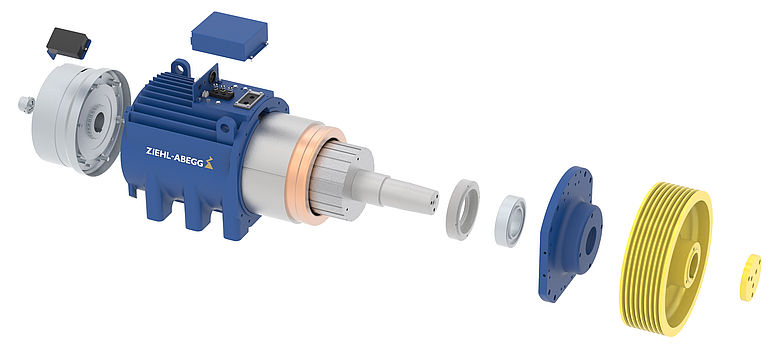
What is an Elevator Motor?

An elevator motor is an electric motor (electromechanical power machine), specifically designed to convert electrical energy into vertical mechanical movement for transporting people or loads in an elevator (also called a lift). The elevator motor is therefore an integral part of the elevator drive system, which typically consists of the elevator motor, a braking system, a traction sheave, and other components.

The operation of elevator motors is designed to ensure reliable and smooth movement, taking into account load capacity, speed, energy efficiency and noise levels, depending on the installation situation.

» Reliable & efficient in every installation situation: Elevator drives from ZIEHL-ABEGG

How is an Elevator Motor Constructed?

A typical elevator motor consists of several main components whose interaction generates the required driving force for the movement of the elevator:

  • Fixed stator: The stator is usually a laminated core equipped with windings, which generates an electromagnetic rotating field when an electric current is added.
     
  • Movable rotor (runner): The rotor, also called runner, is the rotating component of the electric motor.
    Elevator motors designed as permanent magnet synchronous motors have an alternatingly poled arrangement of permanent magnets in the rotor. The speed is synchronous to the electrical frequency of the stator field.

    In asynchronous motors, the speed deviates asynchronously from the electrical frequency because the rotor's magnetic field must be impressed by the stator current, causing the rotor to follow with a delay (slip). Therefore, the rotor has windings instead of magnets. The rotor winding is usually a squirrel-cage winding made of copper or aluminium bars.
    Depending on the design, the rotor can be mounted inside the stator (internal rotor) or outside around the stator (external rotor).
     
  • Housing: The electrical connection box is located in the housing.

Housing with electrical junction box

Stator lamination pack with windings

Rotor stack with permanent magnets (synchronous motors) or rotor windings (asynchronous motors)

Motor shaft

How Does a Lift Motor Work?

In principle, all rotary electric motors consist of a stationary, motionless stator and the spinning rotor.

When a three-phase winding is energised with alternating current, it generates a rotating electromagnetic field. Between the stator and the rotor there is a narrow air gap, which forms the interaction surface between the rotating electromagnetic field and the permanent magnets, or more precisely, the rotor winding. Physically, there is an attraction between different pole pairs and a simultaneous repulsion between identical pole pairs. The rotating stator field circulates in the air gap and pulls the corresponding magnetic rotor poles along with it.

External rotor elevator motors have a significantly larger magnetic interaction area than Internal rotor motors and can therefore generally achieve higher torque within the same volume. Internal rotor motors on the other hand, allow for particularly narrow and long designs, which are more suitable for installation in an elevator shaft.

Types of Elevator Motors

Regardless of the operating principle, elevator motors can be designed as synchronous or asynchronous motors, with or without gears.
Modern elevator systems generally use gearless technology because it is particularly low-maintenance, efficient and quiet in operation. At the same time, these designs are particularly advantageous for installation in the elevator shaft. 
Because elevators are increasingly built without a machine room, geared elevator motors have now been almost completely replaced by gearless drives.
 

Quality features of elevator motors

To ensure that the selected system always meets the desired requirements, the quality features of drive systems include:

  • Efficiency: High-quality elevator motors are designed for high energy efficiency, resulting in lower energy consumption and therefore lower operating costs. A positive side effect is the saving of resources, which contributes to sustainability. 
     
  • Precise Torque Control: To ensure the most efficient operation while minimising vibration, the electromagnetic circuit consisting of the stator and rotor must be carefully optimised.
     
  • Silent Operation: To increase passenger comfort and reduce the general noise level in buildings, high-quality elevator motors are specially designed for silent operation.
     
  • Reliability: To minimise downtime and ensure maximum safety at all times, reliable operation is of the utmost importance. Gearless lift motors in particular require no maintenance - o  nly add-on components such as the drive discs and the brake system require maintenance.
     
  • Compatibility and Flexibility: High-quality elevator motors and drive systems are versatile and can be used in various applications. Connectivity to cloud-based monitoring platforms enables, for example, real-time analytics, sensor data monitoring and preventive maintenance notifications.

» Real-time monitoring anytime, anywhere: ZAbluegalaxy for drive technology


How Do I Find the Right Elevator Motor?

In general, the selection of a suitable lift motor or drive system always depends on the specific requirements of the application, such as load capacity, speed, energy efficiency or noise behaviour and the existing installation situation (e.g. space restrictions, systems with or without control cabinet).

Specially developed design software for elevator drive systems is an essential tool to help you select the optimum combination of elevator drive, Frequency Converter and other components for the application.

For all lift motor or drive system installations, we recommend consultations with qualified specialists to clarify your individual needs, and find the best possible technical solution.

​» Optimize your elevator design: ZAlift design software from ZIEHL-ABEGG


How Do You Replace Old Elevator Motors?

An effective elevator retrofit program provides the opportunity to modernise existing systems and improve their performance, safety and energy efficiency.

The modernisation planning and works must be individually tailored to the specific application and the existing installation conditions.

Retrofit programs typically include a professional inventory analysis, selection of suitable components, their installation and commissioning, as well as training in the operation of the new system.

» Increase the efficiency of your lift system with RETROFITBLUE from ZIEHL-ABEGG

Was This Page Helpful?