Country and language selection
Your country: United Kingdom
Your language: English
Do you want to switch to your country version? Welcome to ZIEHL-ABEGG!
You are visiting our Website from Greece?

On the website for your region you will find information on the products relevant to you, contact details and news.

Unfortunately, there is no Greek language version of our website. However, you can stay on this page or contact our sales representative in Greece directly.
What is an External Rotor Motor?

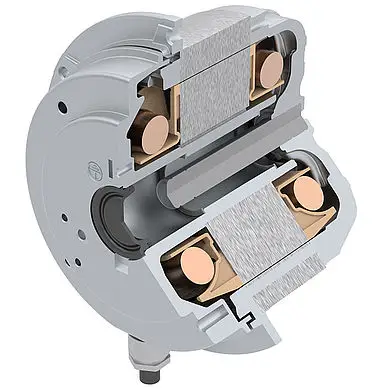
An external rotor motor is a type of electric motor in which the moving rotor ("rotor") rotates externally around the internal, stationary stator. The external rotor motor transfers torque directly from the rotating external rotor, e.g., to a fan impeller mounted directly on the rotor.

Different technologies can be used in the design of external rotor motors. External rotor motors can be designed as  EC-Motors or as AC-Motors.

Highest Efficiency from ZIEHL-ABEGG: External Rotor Motors Ventilation Technology and Elevator Drives.

How Does an External Rotor Motor Work?

In principle, every electric motor consists of a stationary, immovable stator and the rotating rotor, also called the runner.

The internal stator contains windings that generate a rotating electromagnetic field when powered externally. The external rotor generates its own magnetic field: depending on the technological construction, the rotor contains alternatingly polarised permanent magnets (EC Motors) or a laminated core with excited windings (AC Motors).

Due to the attraction of different polarities and the simultaneous repulsion of like polarities, the rotor is moved by the moving rotating field of the stator. In an external rotor motor, the rotor does not rotate in the stator, but around it.

The desired speed range can be controlled electronically using control electronics integrated in the external rotor motor or by connecting a Frequency Converter. 

How are External Rotor Motors Constructed?

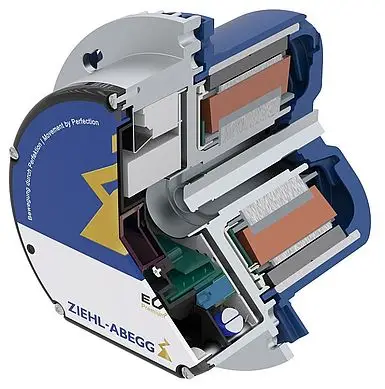
EC external rotor design:

  • Housing
  • Stator bushing with a wound laminated core
  • Printed circuit board with commutation electronics
  • Rotor with shaft and permanent magnets
  • Ball bearings

AC design with external rotor:

  • Housing with a terminal box
  • Stator bushing with a wound laminated core
  • Rotor core with rotor winding or permanent magnets
  • Ball bearings

External Rotor - EC

Housing cover with power connection

Rotor with shaft and permanent magnets

Wound sheet package (stator)

Stator bush

Printed circuit board with commutation electronics

External Rotor - AC

Housing with junction box (terminal box)

Stator bushing with coiled sheet metal package

Rotor sheet package with rotor coiling or permanent magnets

  Highest efficiency from ZIEHL-ABEGG: External rotor motors for Ventilation or Elevator Technology

What Are the Advantages of External Rotor Motors?

  • High Torque: Due to the external rotor, the magnetic field surface is significantly larger than that of an  Internal Rotor Motor with the same components. This generates a greater electromechanical force, resulting in high torque.
  • High efficiency: The large interaction surface between the rotor and stator of EC external rotor motors ensures high Efficiency and relatively low energy consumption.
  • Compact dimensions and robust design: Thanks to the high efficiency between the rotor and stator, the external rotor motor can be designed to be space-saving.
  • Wear- and maintenance-free: External rotor motors, designed as EC Motors, have very little mechanical wear due to electrical commutation.
  • Precisely adjustable speed range: Depending on the technology, it can be controlled via integrated electronics (EC) or an upstream frequency converter (AC).
  • Depending on the application, no gearbox or mechanical transmission is required.
  • Low-noise operation is possible.

What is the Difference Between an Outrunner and an Inrunner?

In an outrunner motor, the stator is located inside the machine and is surrounded by the rotating rotor, which provides the Torque.  Due to the large interaction surface between the rotor and stator, outrunner motors achieve high torque with low energy consumption. The opposite is true for an  Inrunner motor, where the torque is transmitted from the inner rotor to the outside via a stable shaft surrounded by the stator core. Inrunner motors achieve high power density with a low moment of inertia.
 

Where are External Rotor Motors Used?

Due to the unique performance characteristics and advantages of external rotor motors, common application areas include:

Was this page helpful?