Country and language selection
Your country: United Kingdom
Your language: English
Do you want to switch to your country version? Welcome to ZIEHL-ABEGG!
You are visiting our Website from Greece?

On the website for your region you will find information on the products relevant to you, contact details and news.

Unfortunately, there is no Greek language version of our website. However, you can stay on this page or contact our sales representative in Greece directly.

What is an EC Motor?

An EC motor, also known as a brushless DC motor (BLDC motor) or permanent magnet synchronous motor (PSM), is an electric motor that uses permanent magnets and control electronics to convert the supply voltage into a suitable rotating field. The stator windings are alternately supplied with voltage by the control electronics, the motor is thus electronically commutated (EC). This creates a radially moving magnetic field that drives the rotor. EC motors can be built in various designs, either as Internal rotors or External rotors.

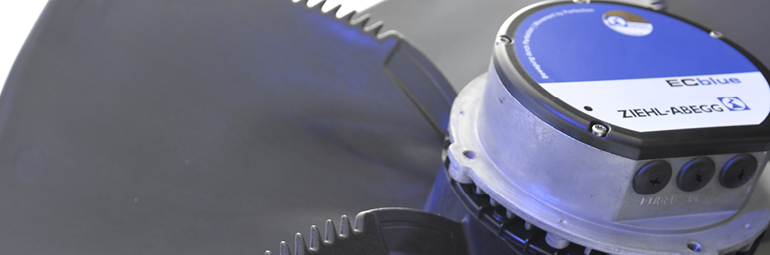
Highest efficiency from ZIEHL-ABEGG: EC Motors for Ventilators.

How Does an EC Motor Work?

In the control electronics (commutation electronics), the alternating current from the power grid is rectified and stored in an intermediate circuit. This intermediate circuit then supplies current to the windings arranged in the stationary stator.

The movable rotor (also called the "rotor"), arranged parallel to the stator, contains permanent magnets with alternating positive and negative polarity. The windings are energised by the commutation electronics in such a way that a rotating magnetic field is created, which sets the rotor in motion. The windings are controlled depending on the rotor position, which is detected by integrated motor position sensors (Hall sensors) or can be calculated by software.

The repulsion of identical polarity and the simultaneous attraction of opposite polarity between the windings and the permanent magnets creates the rotor's rotation. The rotor thus rotates synchronously with the stator's moving rotating field. The desired speed is controlled by the commutation electronics.
 

How are EC motors constructed?

The structure of an EC motor essentially consists of

  • Housing
  • Stator bushing with wound laminated core
  • Printed circuit board with commutation electronics (optional: control electronics and customer interfaces)
  • Rotor with shaft and permanent magnets
  • Hall sensors for position determination (alternative via software possible)
  • ball bearings

Best quality from ZIEHL-ABEGG: With ECblue ZIEHL-ABEGG sets new standards in energy efficiency!

Housing cover with power connection

Stator bush

Printed circuit board with commutation electronics, control electronics and customer interfaces

Wound sheet package (stator)

Rotor with shaft and permanent magnets

What are the advantages of EC motors?

  • Energy efficiency: Effortless compliance with the European Ecodesign Directive for energy-related products (ErP Directive).
  • Predictive maintenance: Direct connection to cloud systems possible.
  • Virtually wear-free: Gentle control of the engine's mechanical components.
  • Integrated control: No need for external controllers.
  • Wide voltage range: To simplify use on different voltage systems, EC motors are equipped with a wide voltage range.
  • Group control: Evaluation possible directly via BUS systems (e.g. MODBUS).
  • Cost-effective due to long service life: Compared to the long product lifespan, the investment costs are relatively low.
  • Retrofit / Modernisation: Existing systems can be replaced with EC motors. Control devices such as frequency converters are no longer required, as these are already integrated into the EC motor.

Permanently low operating costs: Modernise your existing system with the RETROFIT-Program from ZIEHL-ABEGG!

Are EC motors more energy efficient than AC motors?

EC motors achieve higher efficiencies than other electric motors, such as AC-Motors, both under full and partial load.

By using permanent magnets, EC motors require no additional magnetizing current. Consequently, there is hardly any heat loss. The winding arrangement can be tailored to a specific application. This ensures that the EC motor is always within the correct performance range for the end user. The ability to control the speed as needed further significantly reduces energy consumption, especially during partial load operation.

In summary, EC motors are superior to AC motors in terms of energy efficiency. Nevertheless, the use of AC motors can still make sense under certain conditions, for example, if the application does not require special control. Furthermore, AC motors are a robust solution due to their simple design.

EC motor:
Incoming power / Outgoing power

AC motor:
Incoming power / Outgoing power

Where are EC motors used?

Due to the special performance characteristics and advantages of EC motors, common areas of application include:

Are EC motors controllable?

By expanding the control technology with add-on modules, EC motors can be controlled, analysed, and monitored via Bluetooth or various bus systems, depending on the model, in individual or parallel operation. Connecting to a gateway also enables cloud integration. This results in greater operational reliability through rapid detection of malfunctions, improved ease of use, and ultimately more efficient system operation.

​ ZIEHL-ABEGG Quality Made to Measure: System components for ventilation from ZIEHL-ABEGG enable the individual design of your system!

Was this page helpful?