Country and language selection
Your country: Korea
Your language: English
Do you want to switch to your country version? Welcome to ZIEHL-ABEGG!
You are visiting our Website from Greece?

On the website for your region you will find information on the products relevant to you, contact details and news.

Unfortunately, there is no Greek language version of our website. However, you can stay on this page or contact our sales representative in Greece directly.

What are harmonics?

Harmonics are sinusoidal voltage or current components in electrical networks whose frequencies are integer multiples of the fundamental frequency (50 Hz in Europe, 60 Hz in North America, Saudi Arabia, and parts of Japan). They are mainly caused by non-linear consumers that do not consume current in proportion to the applied voltage. These non-linear loads cause distortions in the current and voltage waveforms, which leads to harmonics in the grid.
The presence of harmonics can impair voltage quality and lead to problems such as increased heating of equipment, malfunctions of sensitive devices, or additional losses in the grid. It is therefore important to analyze harmonics and take appropriate measures to reduce them.

How do harmonics arise?

Harmonics are caused by non-linear consumers in the electrical network. These consumers do not consume electricity in proportion to the applied voltage, which leads to distortions in the current and voltage curves.

This is how harmonics arise in the grid

1. Nonlinear loads: Devices such as frequency converters, switching power supplies, LED drivers, or electric welding machines have nonlinear characteristics. They draw current in pulses or only during certain phases of the mains voltage.

2. Distortion currents: These nonlinear current draws cause distortions in the mains current. The resulting current waveform contains additional frequency components in addition to the fundamental frequency (50 Hz or 60 Hz).

3. Fourier analysis: From a mathematical point of view, every distorted current or voltage waveform can be represented as the sum of sinusoidal oscillations of different frequencies. These additional frequency components are the harmonics, whose frequencies are integer multiples of the fundamental frequency (e.g., for a fundamental frequency of 50 Hz: 150 Hz for the 3rd harmonic, 250 Hz for the 5th harmonic, etc.).

4. Reaction on the grid: The harmonics generated feed back into the supply grid and have a negative impact on other consumers or equipment.

Networks with a high proportion of power electronics are particularly affected, as modern electronic devices often do not consume sinusoidal currents. This increases the degree of distortion and can place an increasing strain on the network.

Effects of harmonics

Harmonics cause a number of problems in electrical networks and equipment. The most important ones are:

 Increased heating reduces the service life of electrical appliances

 Overloading of the power grid and resonance effects

  • Harmonics can resonate with the network impedance, leading to dangerous voltage distortions and overcurrents.
  • This increases the risk of equipment damage or network instability.

 Malfunctioning of electronic devices

  • Controls, protective relays, and sensitive measuring devices can be disrupted or triggered incorrectly by harmonics.
  • Data loss or communication errors can occur in IT systems.

 Impairment of voltage quality

  • Distortions in the grid voltage caused by harmonics can have a negative impact on other consumers in the grid.
  • A high distortion content (THD – Total Harmonic Distortion) leads to poor grid quality.

 Reduced energy efficiency

  • The additional reactive power and higher losses caused by harmonics lead to inefficient energy consumption (reduced power factor).
  • In large systems, this can result in significant additional costs.

To avoid these problems, harmonic filters, active compensation systems, and optimized grid structures are necessary.

Harmonics and reactive power

Harmonics cause a special form of reactive power known as distortion reactive power (Qd).

  • In an ideal network with purely sinusoidal voltage and current, there is only displacement reactive power (Q1), which is caused by phase displacement between current and voltage.
  • Harmonics generate additional distortion currents that do not contribute to active power but still load the grid.
  • These distortion currents lead to losses due to eddy currents and remagnetization, which causes increased heating of transformers, lines, and motors.

Since conventional reactive power compensation systems (e.g., capacitor banks) are usually only designed for displacement reactive power, they cannot compensate for the distortion reactive power caused by harmonics. Instead, active filters or special chokes are required.

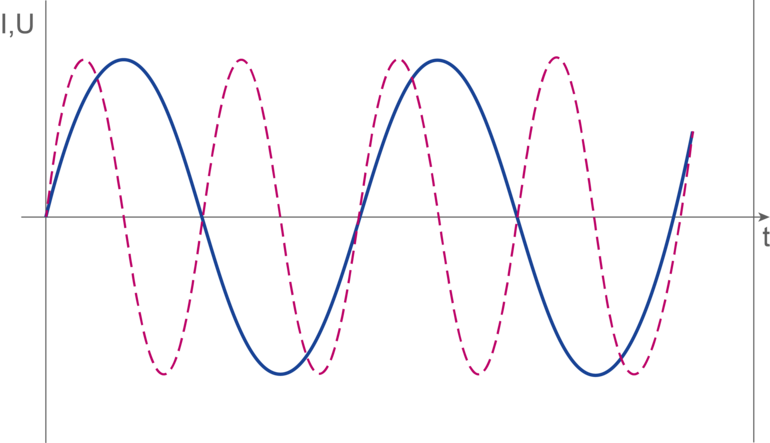
Sinusoidal fundamental frequency f (1st harmonic)

Phase shift: 2nd harmonic (2f)

4. harmonic (4f)

Fundamental frequency f (dark blue), harmonics (magenta), and distorted frequency (light blue)

Measuring and calculating harmonics

Harmonics can either be measured directly or calculated mathematically. Both methods provide important information about power quality and possible countermeasures.

How can harmonics be measured?

Harmonics are detected using special power analyzers or oscilloscopes with FFT functionality. These devices record the current and voltage curves and break them down into their harmonic components using Fourier analysis.

Key metrics

  • Total Harmonic Distortion (THD-U, THD-I): Total distortion content of voltage (U) and current (I), expressed as a percentage (%).
  • Individual harmonics (H2, H3, H5, …): Amplitudes of the individual harmonic orders, expressed as a percentage of the fundamental frequency (%) or in absolute values (volts [V] for voltage, amperes [A] for current).
  • Spectrum of harmonics: Shows the distribution of frequencies (in Hertz [Hz]) and their amplitudes.

How can harmonics be calculated?

In principle, harmonics can be calculated analytically or numerically, e.g.:

  • Fourier analysis: Decomposes a distorted signal waveform into its harmonic components.
  • Simulation programs (e.g., PSCAD, MATLAB, PSpice): Allow the calculation of harmonic currents in complex networks.
  • Empirical formulas: In practice, approximate calculation models are used to estimate typical harmonic currents from known consumers.

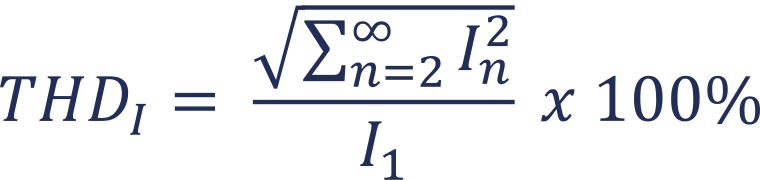
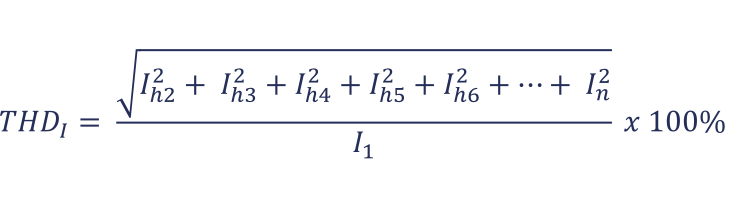
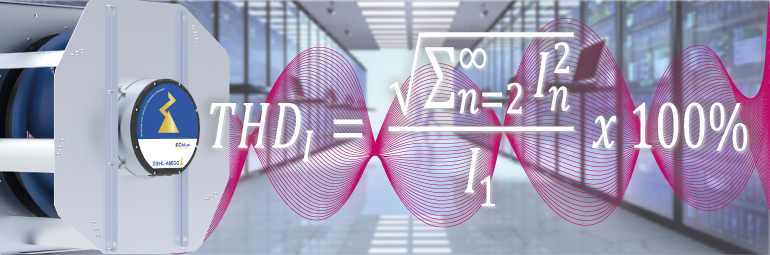
In practice, the total harmonic distortion (THDI) is often calculated and expressed as a percentage. The THD value thus describes the influence of all harmonics on the total current or total voltage. A high THD value means a strong distortion of the current or voltage waveform.

THD for current
THD for voltage

Sample calculation: What is the THD?

Task

Given: A nonlinear consumer generates the following currents

  • Fundamental frequency (50 Hz): I1 = 10 A
  • 3rd harmonic (150 Hz): I3 = 3 A
  • 5th harmonic (250 Hz): I5 = 2 A
  • 7th harmonic (350 Hz): I7 = 1 A

Required:

  • Total harmonic distortion THDI
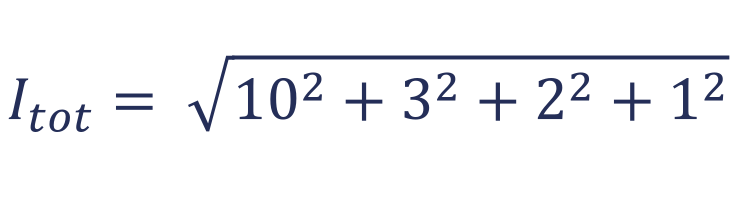
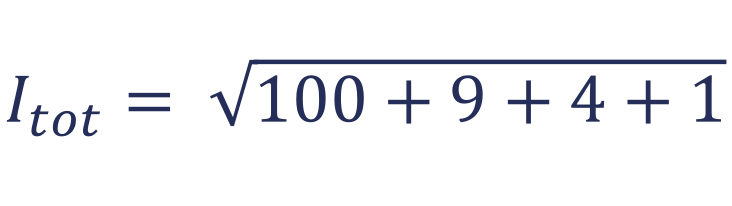
  • Total current Itot

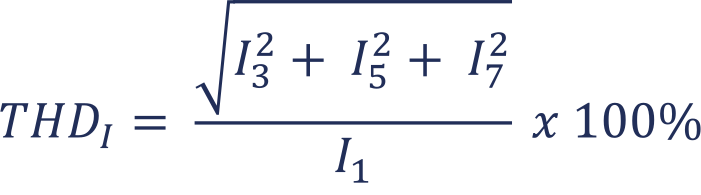
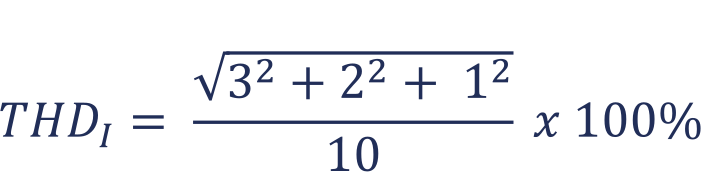
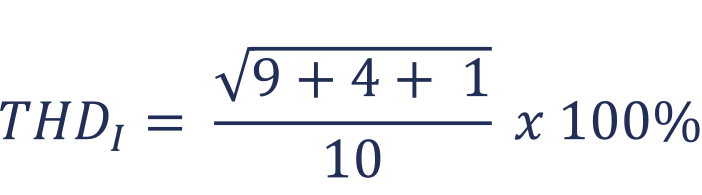
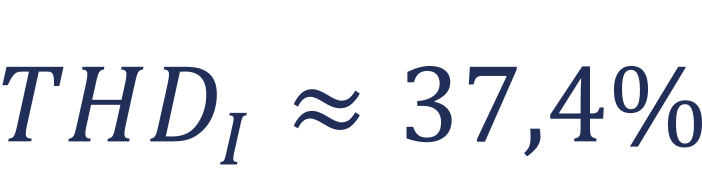
Calculation THDI

Result: The total distortion content of the current is 37.4%.

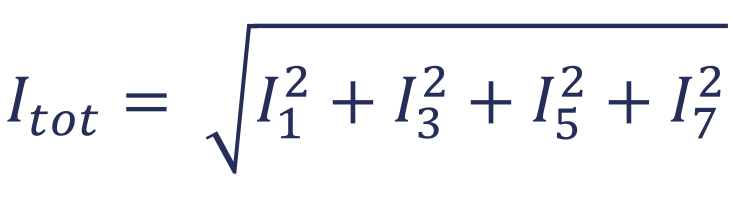
Calculation Itot

Result: The actual total current is 10.68 A instead of the 10 A of the fundamental wave. Thus, the harmonics cause an increase in the total current.

Interpretation

  • A TDHI of 37.4% indicates significant current distortion and thus high reactive power.
  • The increased total current reduces efficiency and thus the cost-effectiveness of the application.
  • Additional components, such as mains filters (e.g. 3-phase aPFC Filter) are recommended

Lower harmonics - higher performance: Discover our EC motor with integrated aPFC filter!

Evaluation and standardization of harmonics

The limits for harmonic currents are specified in international standards:

  • IEC 61000-3-2 specifies limits for harmonic currents of electrical devices with an input current of ≤ 16 A, regulates their measurement, and divides the devices into four classes.
  • IEC 61000-3-12 specifies limits and test methods for harmonic currents of devices with a reference current above 16 A to 75 A.
  • IEEE 519 defines limits for harmonic distortion in electrical systems and serves as a guideline for the design of electrical installations.
  • EN 50160 specifies the characteristics of the supply voltage in public power grids, including harmonics and high-frequency voltages.

Reduce harmonics

In general, harmonics can be reduced by various measures. Technical solutions are often used for this purpose.

Examples of measures to reduce harmonics:

  • Selection of products with integrated solutions
    Active Power Factor Correction (aPFC): Particularly suitable for variable loads.
     
  • External harmonic filters
    Active harmonic filters (AH filters) can detect harmonic currents and compensate for them in a targeted manner
    Passive filters: E.g., mains chokes or capacitors and inductors compensate for harmonic frequencies
     
  • Use of more powerful transformers
    Transformers with the highest possible RSC value (short-circuit ratio)

Ideal for critical infrastructure such as hospitals, data centers, or industrial production facilities: Active harmonic filters from ZIEHL-ABEGG protect your application from power grid distortions and power losses!

Harmonics in ventilation technology

Harmonics play a crucial role in ventilation technology, especially in ventilation systems used in buildings, industrial plants, and critical infrastructure. They affect not only the efficiency and longevity of the systems, but also the security of supply and operational safety.

Modern ventilation systems consist of speed-controlled drives, which are often operated with integrated control electronics (EC motors) or external frequency converters (AC motors). These converters are typical generators of harmonics, as they place a non-linear load on the mains power supply.

Stable ventilation systems are essential for operational safety and health protection, especially in critical infrastructure such as hospitals, data centers, airports, and clean rooms.

Conclusion: Why must harmonics be minimized in ventilation systems?

  • Efficiency: Reduction of energy losses and unnecessarily high operating costs.
  • Durability: Protection of motors, converters, and controls against overload.
  • Reliability: Critical infrastructure must not be endangered by grid distortions.
  • Sustainability: High grid quality is a prerequisite for energy-efficient buildings of the future.

Was this page helpful?