Country and language selection
Your country: Korea
Your language: English
Do you want to switch to your country version? Welcome to ZIEHL-ABEGG!
You are visiting our Website from Greece?

On the website for your region you will find information on the products relevant to you, contact details and news.

Unfortunately, there is no Greek language version of our website. However, you can stay on this page or contact our sales representative in Greece directly.

What is the volumetric flow rate?

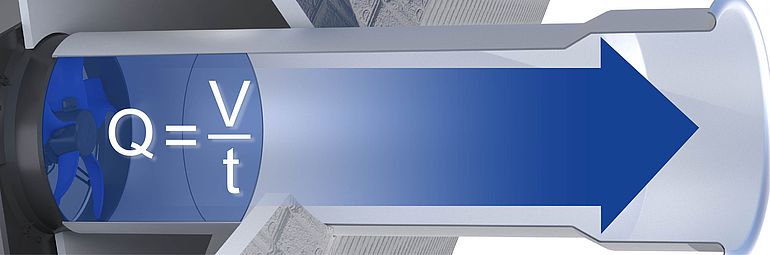
The volumetric flow rate (often referred to as volume flow rate or flow rate) is a physical variable from the field of flow mechanics. It specifies the volume of a medium (e.g. air) that is conveyed through a defined cross-section in a certain time period. 

The volumetric flow rate Q thus describes the displaced volume V over the time t: Q = V/t

The unit used to specify the volume flow varies depending on the underlying reference variable, e.g. m³/s, m³/h, l/h, etc.

 Which fan offers the optimum volume flow for your application? Use the selection software FANselect from ZIEHL-ABEGG to find out.

Calculating the volumetric flow rate

If you want to calculate the volumetric flow rate Q, you can use different variants of the volumetric flow rate formula. Examples: 

  • Q = volume V/time t
  • Q = Mean speed cm x cross-sectional area A
  • Q = mass flow m/density ρ

What does the volumetric flow rate tell us?

The volumetric flow rate quantifies the movement of media (e.g. air) within a technical application and thus represents a performance factor for ventilation systems, such as fans.

The volumetric flow rate depends on the flow velocity of the medium and the cross-sectional area of the flow channel. A higher flow rate or a higher cross-sectional area leads to a higher volumetric flow rate.

Continuity equation

The continuity equation states that the volumetric flow rate at constant density in the unbranched system is constant at every point

This results in the formula Q = A1 x c1 = A2 x c2 = A3 x c3 ...

Q = A x c = constant

In practice, this means a negative correlation between the cross-sectional area A and the air velocity c: If the cross-section of an unbranched air duct increases, the air flow slows down. If the cross-section narrows, the air is accelerated. 
This relationship is particularly important when designing a system depending on the specific installation situation. Optimum air routing and dimensioning of the air ducts can have a considerable influence on the efficiency and aerodynamic noise development, caused by friction effects between the flowing air and the air duct, of certain applications.

Technical relevance of volumetric flow rates

Optimum volume flow is a critical parameter for the power and efficiency of many technical applications, for example: 

Volume flow & energy efficiency

The volumetric flow rate indicates how much air or other gaseous media a fan can convey within a given unit of time. If a fan can achieve a particularly high volume flow rate, it can move more air per unit of time and thus operate particularly effectively. If the fan achieves a certain volume flow rate with low energy consumption at the same time, it is considered to be particularly efficient

Design characteristics of the fan, such as design, number and design of blades and wings, surface finish, inclination angle, etc. can significantly influence the achievable volume flow rate and thus the efficiency of the fan. Optimum adjustment of all system components to the respective use case is crucial for the energy efficiency of the system.

 ZIEHL-ABEGG fans stand for optimum performance with maximum energy efficiency

Correlation between volume flow and pressure

When designing ventilation systems, the volume flow in relation to the pressure must meet the specific requirements of the application. The more precisely the performance parameters are matched in line with the given installation conditions (e.g. length and cross-section of the air duct, installation dimensions, etc.), the easier it is to find the most efficient combination of impeller, motor technology and other system components. The sum of all pressure losses in the system in relation to the volume flow is shown in the system characteristic curve.

  • Volume flow rate: Based on the requirements of the application (e.g. the size of the room to be ventilated, the required ventilation rate or specific process requirements), the system must convey a certain amount of the medium in order to adequately fulfil its purpose.

    When it comes to the design of the system, the following applies: If high volume flows are required at comparatively low pressure levels, the use of axial fans is recommended.
     
  • Pressure: The pressure of ventilation systems (system pressure) determines the system’s ability to transport the medium to be conveyed through the system and overcome obstacles such as filters, air ducts, throttle dampers, air outlets, etc.. More complex systems, e.g. clean-room ceilings or extraction systems with long ducts and various filters, must therefore be able to create higher pressures compared to free-hanging fans for stable ventilation.

    When it comes to the design of the system, the following applies: If high pressures are required with comparatively low volume flows, the use of centrifugal fans is recommended.
Grafischer Vergleich von Volumenstrom-Druck-Korrelation mit beispielhaften Kennlinien eines Axialventilators und eines Radialventilators

System characteristic curve
(Example illustration)

Characteristic curve of a centrifugal fan
(Example illustration)

Characteristic curve of an axial fan
(Example illustration)

Practical example

The higher the pressure loss (e.g. due to obstacles in the air duct, friction or dimensional resistance) in a system, the more energy the fan needs to adequately fulfil the purpose of the application. From the point of view of the user, the pressure loss should therefore be as low as possible for efficient operation.
Structural measures, such as larger heat exchangers, shorter air ducts, larger cross-section of pipes, etc. can reduce the pressure loss. Although this increases the space requirement and, in part, the construction costs of the system, the fan can be operated with significantly lower energy and also with lower noise levels. The more efficient design of the system thus reduces the operating costs over the entire operating time, which in practice usually leads to a higher overall saving for the user. 

Conclusion: In order to achieve the most efficient operation, optimum acoustics and the highest economic efficiency of a system over its service life, numerous factors must be taken into account. Often, the best compromise between the given underlying conditions and the system configuration must be found from the point of view of the user.

 ZIEHL-ABEGG is happy to help you create the ideal design for your system. Please get in touch!

Was this page helpful?