Country and language selection
Your country: USA
Your language: English
Do you want to switch to your country version? Welcome to ZIEHL-ABEGG!
You are visiting our Website from Greece?

On the website for your region you will find information on the products relevant to you, contact details and news.

Unfortunately, there is no Greek language version of our website. However, you can stay on this page or contact our sales representative in Greece directly.
What is a fan?

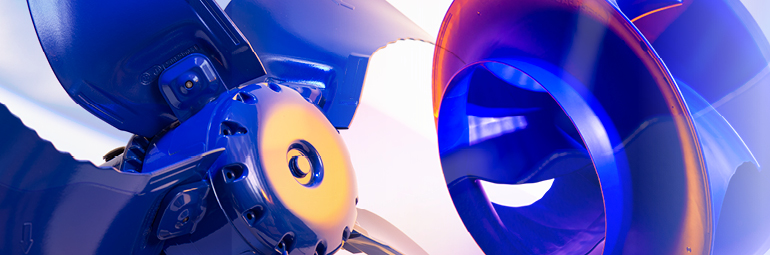
A fan (also known as a “ventilator”) is a flow machine, usually driven by an electric motor, and conveysair or other gaseous media. Depending on the application requirements and installation situation, there are different types of fans, e.g. axial fans, centrifugal fans or crossflow fans. In principle, the basic design of allfans consists of an electric motor and an impeller with blades or paddles, which sets the air in motion by means of rotation. By selecting the correct impeller/motor combination, as well as optional additional components, such as housing, control technology, inlet and outlet grid, etc., the system can be calculated according to the individual needs of an application.

 Maximum performance and maximum efficiency: Ventilation systems from ZIEHL-ABEGG

How does a fan work?

Fans have the task of conveying air or other gaseous media, irrespective of their type or design.

The basic equipment package of each fan consists of an impeller and an electric motor that drives the impeller. The electric motor causes the impeller to rotate. The impeller in turn moves the air by drawing it in on the suction side of the system and blowing it out again on the pressure side.

The design of the fan influences both the direction from which the air is drawn in and blown out again (axial, radial, diagonal, tangential) as well as the system's design-related performance characteristics (e.g. volume flow, pressure, etc.).

How are fans constructed?

  • Impeller: Since fans are used in a wide variety of applications with an equally wide array of different requirements, a distinction is made between different types of fans
     
  • Motor: Fans can be operated with different drive concepts depending on the requirements. Since performance losses occur in every component of a system, it is crucial to fine tune each component when designing a system to achieve the highest possible system efficiency.
    Ventilation systems with a direct drive are often operated by permanent magnet electric motors as BLDC motors, or by EC motors or AC motors, which can be designed as internal rotor motors or external rotor motors.
     
  • Control technology: A system can be equipped with a wide range of additional functions through the use of control technology. There are numerous expansion options, from speed control and a connection to cloud systems through to group control in various BUS systems, etc.
     
  • Additional components: Modern systems can be calculated precisely as required using additional components (e.g. housing, inlet and outlet grid, diffusor, contact protection, etc.).

What types of fans are there?

An important goal of fan manufacturers is to make fans that achieve the highest possible efficiency in terms of the application in question. In order to meet these requirements as precisely as possible, a distinction is drawn between several types of fans whose names are based on the way in which the air flows through the impeller:

Axial fans

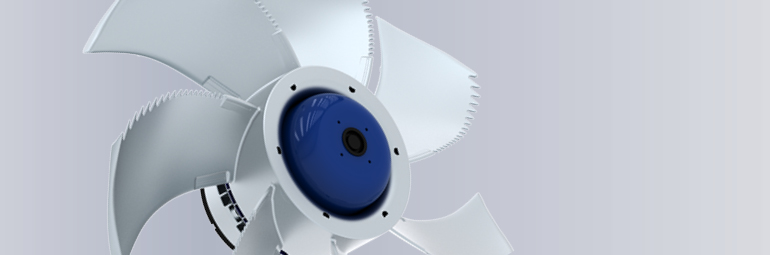
Axial fans, also known as axial ventilators, work in a similar way to aircraft propellers or a ship’s screw. The impeller equipped with a blade configuration conveys the air parallel to the drive axle (axial) from the suction side to the pressure side of the system. They are typically used in applications where large air volumes (high air flows) must be conveyed with low levels of pressure resistance.

​Highly efficient volume flows, minimal noise generation: Axial fans from ZIEHL-ABEGG
 

Diagonal fans

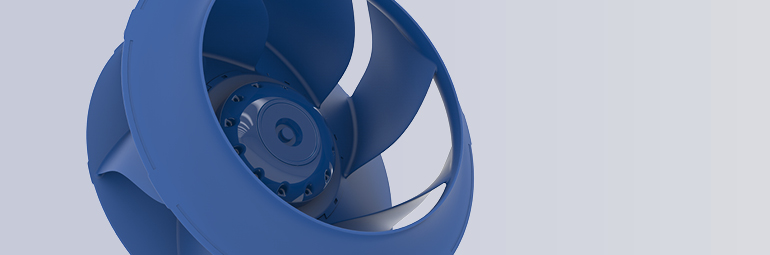
Diagonal fans are a mixture between axial and centrifugal fans with conically shaped blades in the impeller. The air is sucked in axially and flows outwards diagonally to the rotary axis. The compact design facilitates high volume flow rates in confined installation conditions. They are typically used when axial fans create too little pressure for the application and centrifugal fans create too little airflow.

  Highest performance and efficiency values: ZAvblue from ZIEHL-ABEGG
 

Centrifugal fans

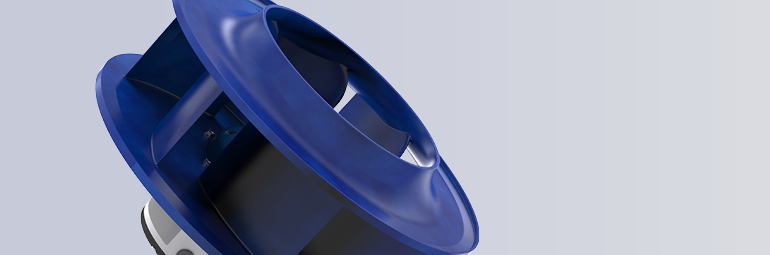
In the case of centrifugal fans, also known as radial fans, the air is sucked in in parallel to the drive axle (axial) and flows out again in a radial direction, at right angles to the rotary axis. They are typically used in applications where higher pressure is required. Design measures, such as the number, shape and geometry of the blades, can influence the way the impeller works. 

 Powerful, highly efficient and low noise: Centrifugal fans from ZIEHL-ABEGG


Crossflow fans

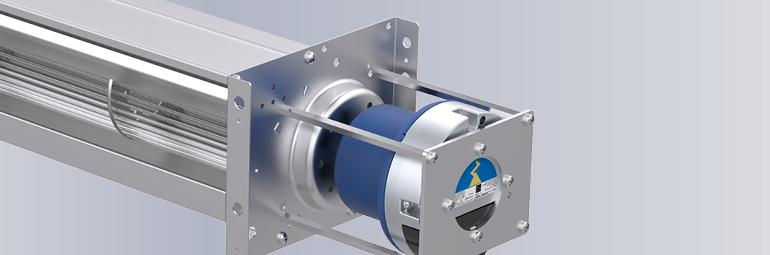
In the case of crossflow fans, also known as crossflow ventilators or tangential fans, the air is sucked in in a tangential direction by means of blades that curve forwards in the direction of rotation and flows out again over a large area, also tangentially. Crossflow fans can convey large air volumes over a wide outlet area and are therefore used, for example, in blower convectors or to generate air curtains.

  Optimal air guidance: Q-series from ZIEHL-ABEGG
 

Where are which type of fans used?

Axial fans
Diagonal fans
Centrifugal fans
Crossflow fans

What makes a fan quiet?

Flow-related phenomena are often the reason why dominant noises are generated while a fan is running. The fan accelerates the air, sets it in motion and thus provides an air flow. The air is deflected on the fan's blades. The more powerfully this is deflected, the more pressure the fan can provide. Swirling or turbulence of the air occurs at various points on the fan (leading and outlet edge, head gap or surface). In addition to the operating point, their appearance and characteristics are also significantly dependent on the installation situation.
However, an optimum blade geometry design can significantly improve the various flow situations and thus reduce sound radiation. When it comes to developing optimum fan aerodynamics, biomimetics can provide innovative approaches to improving efficiency, noise development or operating behaviour.

Examples:

  • Specially designed blade edges: Sickle-shaped blades, trailing edge serration, leading edge shafts,...
  • Surface structures on the blade or wing
  • Blade or wing fluting
  • Winglets at the end of the blade
  • etc.

“Fan” or “Ventilator”?

In addition to the typical term “fan", other terms such as "ventilator” or “blower” are also used in day-to-day language. In fact, the different names are used very differently in practice. From a technical point of view, “ventilator" or "blower" are simply synonyms for "fan”.

Was this page helpful?