Country and language selection
Your country: United Arab Emirates
Your language: English
Do you want to switch to your country version? Welcome to ZIEHL-ABEGG!
You are visiting our Website from Greece?

On the website for your region you will find information on the products relevant to you, contact details and news.

Unfortunately, there is no Greek language version of our website. However, you can stay on this page or contact our sales representative in Greece directly.

What is an axial fan?

An axial fan (also referred to as an axial ventilator or blower) is a special type of fan design, which draws in and discharges air or other gaseous media in the direction of the motor axis or parallel to the drive axle.
The rotation of the blades (also known as “wings” or “propellors”) fitted on the impeller drives the air movement using aerodynamic forces. Air is also discharged in the axial direction.

 Maximum efficiency in a wide range of applications: Axial fans from ZIEHL-ABEGG

How does an axial fan work?

The impeller is powered by an electric motor and the air is conveyed in the direction of the motor shaft axial direction.
An axial fan impeller's blades are arranged in a similar way to an aircraft propeller or ship screw. The air is drawn in from the suction side upstream of the fan axially to the impeller's rotary axis and transported outwards through the system to the pressure side.
Design measures, e.g. number and angle of the blades, shape properties, etc., mean that the axial fan can be calculated according to the requirements of specific applications.

How are axial fans constructed?

Each axial fan typically consists of an impeller and an electric motor that drives the impeller.
Depending on the type or version of the motor, the speed can be controlled via additional electronic components (e.g. frequency inverter). These control electronics are already permanently integrated into modern motors.
The motor/impeller combination needs something to hold it, also known as a suspension, which often has integrated contact protection. This suspension is attached to a nozzle where the impeller is located. A distinction is drawn between numerous nozzle variants. A nozzle with a good aerodynamic design consists of an inflow and a cylindrical area. To maximise efficiency, the nozzle is equipped with a guide vane. Often round nozzles or nozzles with a square cut are chosen.

Motor, impeller, suspension and nozzle form a basic axial fan package. Depending on the use case, the rotating parts (motor and impeller) can be protected against ingress of foreign objects by the installation of a guard grille.

A large number of additional components enable axial fans to be adapted to specific application and installation situations, e.g.:

  • Terminal box: Provides a clearly defined interface for connection.
  • Heating tape: Prevents icing between the impeller and nozzle in refrigeration technology applications.
  • Additional diffusor: Can be used to maximise efficiency.

Axial fan impeller

Electric motor (e.g. EC motor, AC motor, etc.)

Suspension with guide vane

 Find out the ideal combination of ventilation system components to meet your individual requirements with the selection software FANselect from ZIEHL-ABEGG!

How are axial fans installed?

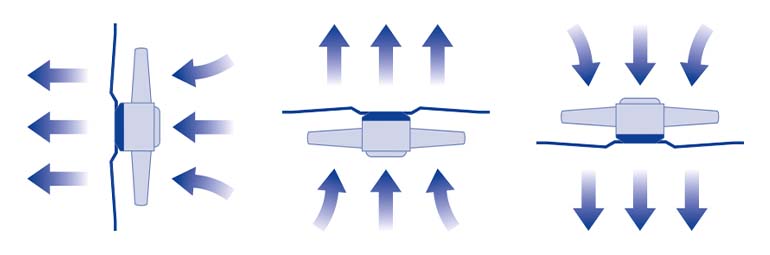
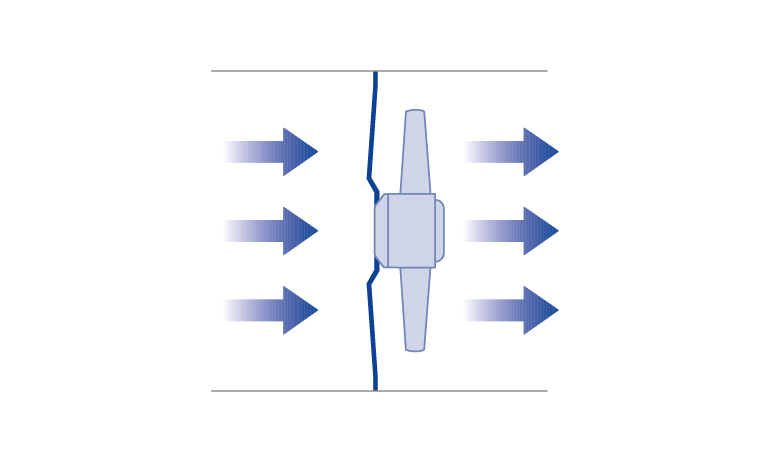
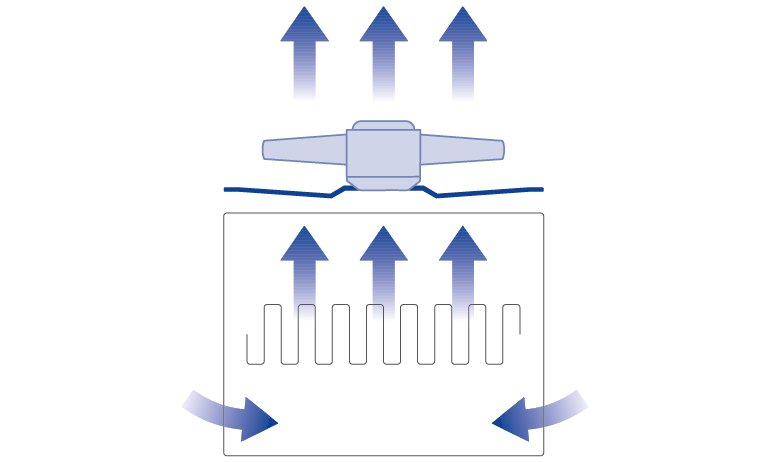
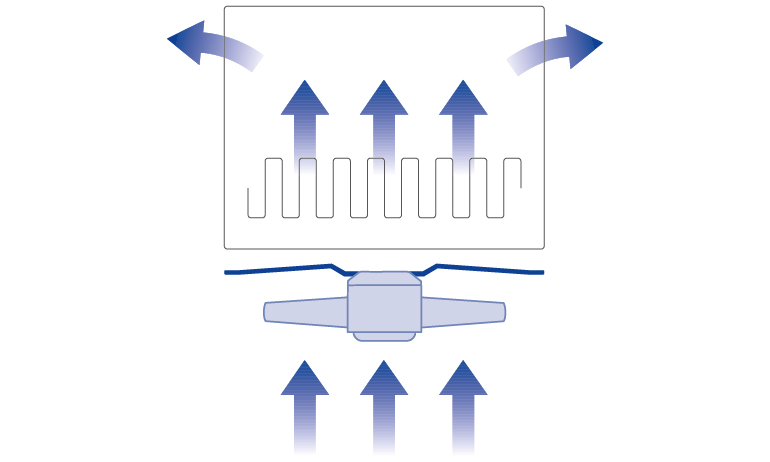
There are four different installation options for axial fans:

  • Recirculation fans are usually suspended from a ceiling and are not flange-mounted on any side. In this installation situation, these fans do not create static pressure, as they only circulate the air in the room.
     
  • Flange-mounted fans normally do not have a pronounced inflow. They have a standardised flange on both sides of the nozzle, which enables the fan to be installed in ventilation ducts for ventilating buildings. 
     
  • Fans flanged on the suction side (single-sided flange mounting) extract the air from a room and distribute it homogeneously via the heat sink. The temperatures of the cooling circuit must be taken into account in the design. 
     
  • Fans flanged on the pressure side (single-side flange mounting) push fresh air into a room. The high temperatures of the cooling circuit have no influence on the fan, but air distribution at the heat sink is inhomogeneous. 

What are the advantages of axial fans?

  • Compact design: The small footprint allows for flexible installation situations in the horizontal and vertical direction.
  • Straight air guide: The direct intake and emission of air facilitates efficient flow behaviour.
  • High air flow: Ideal for applications where large air volumes need to be moved.
  • Flexibility: The needs-oriented system design and the option to expand the fan with additional components mean that a wide range of applications are possible.
  • Easy to install: Due to the simple system design, the effort and costs for installation remain comparatively low.
  • Retrofitting/upgrades: Existing systems can be replaced with new, more efficient models, enabling operating costs to be reduced for good.

 Maximum efficiency with permanently low operating costs: Upgrade your existing system with the RETROFIT programme from ZIEHL-ABEGG!

Where are axial fans used?

Axial fans are used where high airvolumes have to be moved with low levels of pressure resistance, e.g.: 

What makes axial fans quiet?

Flow-related phenomena are often the reason why dominant noises are generated while an axial fan is running. The fan accelerates the air, sets it in motion and thus provides an air flow. The air is deflected on the fan's blades. The more powerfully this is deflected, the more pressure the fan can provide. Swirling or turbulence of the air occurs at various points on the fan (leading and outlet edge, head gap or surface). In addition to the operating point, their appearance and characteristics are also significantly dependent on the installation situation.

However, an optimum blade geometry design can significantly improve the various flow situations and thus reduce sound radiation. When it comes to developing optimum fan aerodynamics, biomimetics can provide innovative approaches to improving efficiency, noise development or operating behaviour.

Examples:

  • Specially designed blade edges: Sickle-shaped blades, trailing edge serration, leading edge shafts,...
  • Surface structures on the blade
  • Blade fluting
  • Winglets at the end of the blade
  • etc.
     

“Axial fan” or “Axial ventilator”?

In addition to the typical term “axial fan”, other terms such as "axial ventilator” or “axial blower” are also used in day-to-day language. The different terms are used very differently in practice. From a technical point of view, “axial ventilator” is merely a synonym for "axial fan".

Was this page helpful?