Country and language selection
Your country: Thailand
Your language: English
Do you want to switch to your country version? Welcome to ZIEHL-ABEGG!
You are visiting our Website from Greece?

On the website for your region you will find information on the products relevant to you, contact details and news.

Unfortunately, there is no Greek language version of our website. However, you can stay on this page or contact our sales representative in Greece directly.

What is efficiency?

Efficiency describes the ratio of the converted, usable energy or power to the energy or power used. Energy efficiency is therefore a quantification of energy efficiency.
Efficiency is generally indicated by the Greek letter η (eta) and is usually specified as a decimal value or in percent. Since the converted energy is always lower than the supplied energy due to the resulting power losses, efficiency is always less than 1 or 100%.

Example: An electric motor that generates a mechanical power of 0.95 kW from a supplied electrical power of 1 kW has an efficiency of 0.95 or 95%. Consequently, 95% of the supplied electrical power is converted into mechanical power (torque). The remaining 5% represents the power loss caused by heat, for example.

Efficiency levels can also be determined for complex systems consisting of several different components. Looking at all components as a whole, we refer to system efficiency.

 ​Maximum efficiency from ZIEHL-ABEGG: EC motors for fans and elevator drives from ZIEHL-ABEGG impress with particularly high efficiency!

How do you calculate efficiency?

Efficiency levels are calculated using a formula, the numerator of which describes the energy emitted or used (Ex ) while the denominator reflects the energy supplied (Ey ). The efficiency can also be calculated using the power emitted or used (Px ) in relation to the power supplied (Py ).
Energy converters, such as electric motors, convert supplied electrical energy into mechanical kinetic energy. Due to ever-occurring power losses, e.g. caused by friction or electrical resistors, the efficiency can never be 1 or 100% or even higher according to the energy retention set.
If, for example, several conversions take place in succession in complex systems, the product of the efficiency of the individual components forms the system efficiencysys ):
ηsys = η1 x η2 x η3 ...

Efficiency and energy efficiency

Particularly in complex technical machines and systems where several conversions take place in succession, the system efficiency is considered to be a decisive parameter for assessing energy efficiency. Each individual component of the system in which an energy conversion takes place has its own degree of efficiency based on the power losses that occur. For the entire plant to operate as energy-efficiently as possible, the system efficiency should therefore be as high as possible. To evaluate a system in terms of its energy efficiency, the efficiency should be considered in relation to the specific application and installation situation.

 ZIEHL-ABEGG is happy to help you create the ideal design for your system. Please get in touch!

In addition to the component properties, the operating mode can also affect the efficiency of a machine. For example, an electric motor can achieve different degrees of efficiency in full-load or partial-load operation. Consequently, both the full and partial load ranges should be considered for consistently energy-efficient operation of a machine. For example, if a ventilation system is operated with an EC motor, the speed can be precisely adjusted to the desired requirements, meaning that energy consumption can be significantly reduced.

 Top efficiency from ZIEHL-ABEGG: ECblue motors achieve the highest efficiencies in the full and partial load ranges!

The efficiency of electric motors

In principle, there is a lot of energy saving potential in electrical drive systems. Energy savings can have a significant impact on the operator, especially in applications where production machines, ventilation systems or other technical systems that run in continuous service. A globally uniform energy efficiency standard has been defined by the International Electrotechnical Commission (IEC) in the standard IEC 60034-30. This differentiates between electrical drives according to their efficiency class IE1 to IE5:

IE1Standard efficiencyNo longer allowed in Europe
IE2High efficiencyIE2 only allowed in Europe with frequency inverter
IE3Premium EfficiencyElectric motors with standard efficiency
IE4Super premium efficiencyElectric motors with particularly high efficiency
IE5Ultra premium efficiencye.g. synchronous reluctance motors


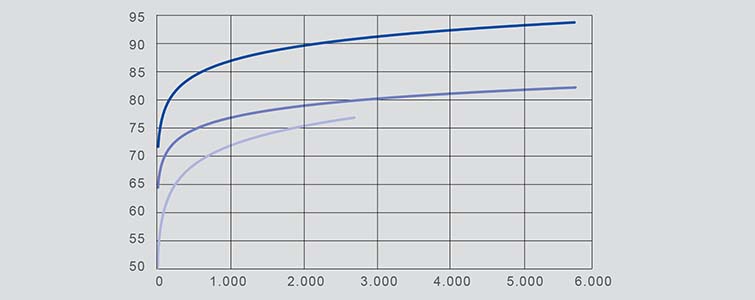
​ ECblue from ZIEHL-ABEGG meets efficiency class IE5 – perfect for brand new ventilation systems or retrofitted upgrades!

Efficiency η in %

Power in W

ECblue motor

AC motor 3~

AC motor 1~

How can efficiency be increased?

The possibilities of increasing the efficiency of energy converters are fundamentally dependent on various factors. Using the example of the electric motor, efficiency is sometimes influenced by the following aspects:

  • Design of an electric motor:
    EC motors as permanently excited synchronous motors, for example, do not require any additional commutation current and are therefore more efficient than externally excited electric motors. Permanently excited synchronous motors designed as external rotors create a large interaction surface between the permanent magnets mounted in the rotor and the windings placed in the stator through the external rotor. An optimally designed winding arrangement for the operating point can enhance the efficiency of an electric motor.
     
  • Materials:
    The use of certain materials, e.g. in relation to the electrical resistor, heat development under electrical voltage or magnetization, can help to reduce power losses.
     
  • Use of control technology:
    For certain application areas, such as heat pumps or ventilation systems, the speed can be regulated, energy consumption in the partial load range reduced and thus the system efficiency increased by connecting control technology (e.g. frequency inverters, pressure sensors, temperature sensors, etc.).
     
  • Software & firmware:
    Intelligent software solutions can help to optimally calculate, control or analyse systems, thus optimising the operating efficiency of connected devices.

 ZIEHL-ABEGG can help you create the ideal design for your system. Please get in touch!

Was this page helpful?