Country and language selection
Your country: Thailand
Your language: English
Do you want to switch to your country version? Welcome to ZIEHL-ABEGG!
You are visiting our Website from Greece?

On the website for your region you will find information on the products relevant to you, contact details and news.

Unfortunately, there is no Greek language version of our website. However, you can stay on this page or contact our sales representative in Greece directly.

What is a frequency inverter?

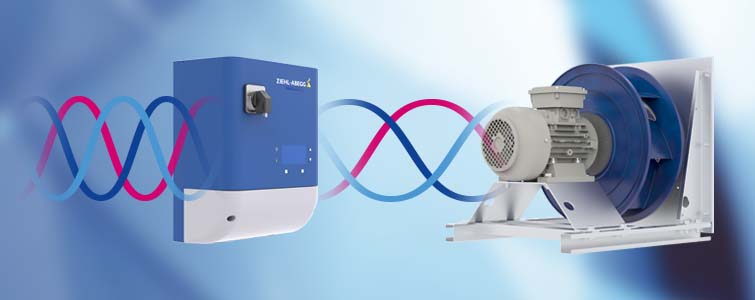
Frequency inverters are electronic devices that create an AC voltage with variable frequency from an AC voltage with fixed frequency (e.g. 50 Hz). They are usually installed between the supply network and an electric motor so that its speed can be controlled steplessly and precisely and so that its energy consumption can be optimised. In addition, a frequency inverter can control the direction of rotation, e.g. for synchronous motors in elevator technology.
In terms of static frequency inverters, a distinction is drawn between direct inverters without a DC-link and DC-link inverters with DC-link voltage.
The frequency inverter selected must be in line with the electric motor to be controlled (synchronous or asynchronous motor).

 ZIEHL-ABEGG develops and supplies carefully tuned frequency inverters for ventilation systems and frequency inverters for elevator drives.

What does a frequency inverter do?

  • Frequency inverters convert fixed line voltage or frequency into variable line voltage or frequency
    The main function of a frequency inverter is to convert the frequency of AC voltage coming from the mains system into a variable frequency so that the speed of the connected motor can be adjusted. Current-driven frequency inverters keep the ratio of current to frequency constant; voltage-driven models stabilise the ratio of voltage to frequency. In Central Europe, the grid frequency is 50 Hz.
     
  • Frequency inverters control the speeds of electric motors
    Frequency inverters first convert the incoming AC voltage into DC voltage and then back into (adjusted) AC voltage. As a result, the downstream motor has a steplessly adjustable speed range between 0 and the rated speed, without losses in torque. As such, frequency inverters expand the power and application spectrum of alternating current motors as without inverters they would only be able to offer “on” and “off” signals without variable speed.
     
  • Frequency inverters increase system efficiency
    If, for example, an asynchronous motor is controlled by a frequency inverter, regulating the speed range also reduces the energy consumption of the electric motor as well as its power loss. In the partial-load range, the frequency inverter thus increases the system efficiency. The exact savings potential is dependent on the load profile of the application. In Europe, certain motor types (IEC2) may only be operated in conjunction with a frequency inverter for reasons of energy efficiency.
     
  • Frequency inverter communication
    Frequency inverters can be integrated into a network or cloud system for seamless monitoring, analysis, or control, depending on the model or enlargement. This means, for example, that power losses or failures can be detected and rectified immediately or the optimum operating point of the application can be achieved at any time.

 The intelligent ZIEHL-ABEGG ZAbluegalaxy cloud allows for real-time diagnostics, remote maintenance, analysis and control of networked devices.
 

Design and function of frequency inverters

The basic design of a frequency inverter consists of just electronic components, without any mechanically moving components.

Frequency inverters are made up of the following main assemblies:

  • Rectifier
    The rectifier converts the AC voltage on the input side into DC voltage. The electrical components needed for this are known as uncontrolled or controlled bridges, such as thyristors or transistors.
     
  • DC-link
    The DC-link, which essentially consists of a capacitor and coils, smooths the incoming DC voltage and then feeds it into the inverter. Depending on the application (e.g. for controlling several fans in parallel mode), several inverters can also be connected to the DC-link. Some types of frequency inverters do not require a DC-link. They require an uninterrupted energy supply.
     
  • Power inverter
    In the power inverter, AC voltage is re-generated from the DC voltage in the DC-link, the frequency of which matches the connected motor or its desired operating point. In addition to the output frequency, the level of the output voltage can also be adjusted. Depending on the version, a sine filter could also be installed to create the optimum sine voltage.
     
  • Control unit or control circuit
    The control circuit typically consists of a control card or fieldbus interface, through which various information can be fed. Based on this information, the control circuit carries out various calculations. This is primarily used to monitor individual components and critical or relevant parameters in the system.

Due to the modular design, frequency inverters can be combined with expansion groups, such as line reactors, filters, signal and communication or control modules, depending on the model version and specific application requirements. With the help of intelligent expansion modules, frequency inverters can be integrated into a network and controlled via Bluetooth, for example, or analysed, managed, calculated or controlled in a cloud.

 Perfectly coordinated: ZIEHL-ABEGG develops and produces frequency inverters for ventilation systems and frequency inverters for elevator technology!


Advantages of frequency inverters

Depending on the application area and its particular requirements, the use of frequency inverters can offer significant advantages, e.g.:

  • Energy-efficiency: Installing a frequency inverter upstream from an electric motor can significantly reduce current consumption and power losses in the partial load range, which can significantly increase system efficiency.
     
  • Reduction of noise generation: Compared to the mains power supply, frequency inverters regulatre connected electric motors without increased stress on the winding insulation and motor bearings for gentle and quiet operation.
     
  • Optimum operating point: Thanks to the high-precision controllability, the optimum operating point of the application and thus the optimum ratio between power and energy efficiency can be achieved.
     
  • Digital monitoring, analysis and control: Integrated into an intelligent network, frequency inverters can be seamlessly analysed, monitored and controlled digitally.
     
  • Modular design: Frequency inverters can be equipped with a variety of add-on modules and interfaces, allowing the functionality to be precisely adapted to the requirements of the application.
     
  • Low lifecycle costs: Acquisition costs represent only a relatively small part of the lifecycle costs. For example, through savings in energy consumption, reduction of wear and tear or power losses, the costs are relative to the life cycle.

How do frequency inverters modify frequency?

In the inverter, AC voltage is once again generated out of the DC voltage from the link circuit, the frequency of which matches the connected motor or its desired operating point.
The desired AC voltage is generated from a stable DC-link voltage via controlled semiconductors (Insulated-Gate Bipolar Transistor (IGBT)). Various modulation methods can be used to create the AC voltage, such as pulse width modulation (PWM), the most common type of modulation. A pulse-width modulated rectangular signal can be used to generate signal shapes at a typically constant frequency. This regulates the output frequency and the level of the motor voltage according to the control system setpoint.
Depending on the version, a sine filter could also be installed to create the optimum sine voltage.

Where are frequency inverters used?

Typical areas of application for frequency inverters include, for example:

Was this page helpful?