Country and language selection
Your country: Finland
Your language: English
Do you want to switch to your country version? Welcome to ZIEHL-ABEGG!
You are visiting our Website from Greece?

On the website for your region you will find information on the products relevant to you, contact details and news.

Unfortunately, there is no Greek language version of our website. However, you can stay on this page or contact our sales representative in Greece directly.

What is a duct fan?

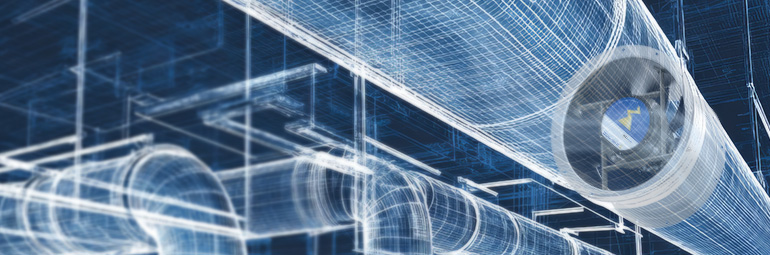
A duct fan (also known as a duct-mounted fan or duct ventilator) is a fan that is installed directly into a duct or channel to transport air or other gaseous media within this duct system. In duct fan applications, fans are usually flanged to both sides of the duct system, depending on the application. This makes the duct fan an integral part of the flow channel and allows it to be used for supply or exhaust air as required.

The modularly designed MAXventowlet medium-pressure axial fan with factory-adjustable blade angles is designed for installation in pipe and flange systems and combines high flow rates with medium operating pressures and quiet operation

What are the benefits of a duct fan?

A duct fan provides targeted air delivery (volume flow) and pressure build-up within closed duct systems. Through controlled air movement, the duct fan thus creates stable flow conditions in the respective application:

  • Volume flow: The volume flow refers to the quantity of the conveyed medium moved in a specific period of time.
  • Pressure increase: In order to move a conveyed medium, it is accelerated by the fan. The resulting pressure increase must overcome pressure losses occurring in the system (e.g., due to resistance, obstacles, branches, etc.).
  • Air quality and comfort: Continuous air exchange, e.g., in buildings, industrial halls, or processes with exhaust air requirements.
  • Compact integration: Due to their direct installation in round pipes or flange systems, duct fans are ideal for limited installation space.

Types of duct fans

The combination of the application requirements (e.g., required pressure, volume flow, etc.) and the installation situation means that a duct fan must have certain characteristics in order to fulfill its purpose reliably and as efficiently as possible. For this reason, different types of fans can generally be used as duct fans:

Axial fans

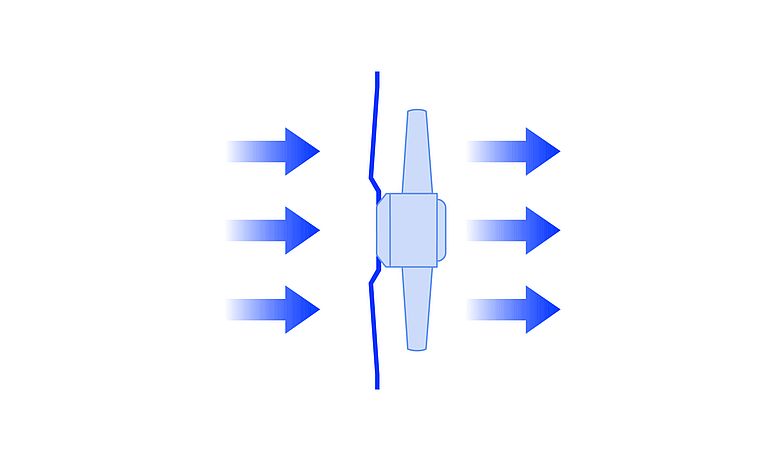
Axial fans move air parallel to the drive axis. They are generally used when large volumes of air (volume flows) need to be transported at low to medium pressure resistances. Example: short pipelines or installation situations with low pressure loss.

Centrifugal fan

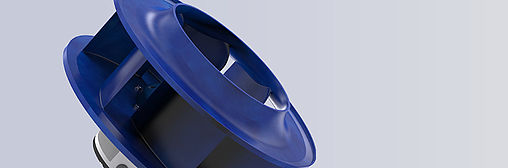
Centrifugal fans draw in air in an axial direction parallel to the drive shaft, deflect it, and discharge it again in a radial direction, perpendicular to the axis of rotation. The air is then collected and aligned again. Radial fans are typically used as duct fans when high resistance must be overcome. Example: Long, branched ducts with built-in filters.

Diagonal fans

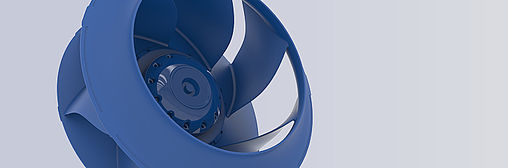
Diagonal fans with conical blades in the impeller are a hybrid between axial and radial fans. They are generally used in applications with limited installation space, where axial fans generate too little pressure and radial fans generate too little volume flow for the purpose of the application.

Axial fans: Favorable ratio of volume flow to size
Applications (examples): parking garages, smoke extraction, etc.

Centrifugal fans: Insensitive to system resistance
Applications (examples): Filter systems, supply air in laboratories, etc.

Diagonal fans: Often the optimal compromise between size, volume flow, and pressure requirements
Applications (examples): mixing applications, HVAC systems, etc.

How do I choose the right design?

In order to ensure the most effective and efficient operation of the system, the exact requirements of the application should be determined:

  • Required pressure increase
  • Required volume flow
  • Space conditions, or installation space, flange size
  • Noise generation
  • Energy consumption or efficiency at the desired operating point
  • Material and environmental conditions
  • Ambient temperature and medium to be conveyed (particularly relevant, for example, in potentially explosive atmospheres with highly flammable gases or dusts)

Intelligent design software can assist in selecting the right components and comparing their technical and economic characteristics.

The FANselect selection software from ZIEHL-ABEGG helps you quickly and easily select the right fan for your application!

How does a duct fan work?

Like all fans, the basic design of a tube fan consists of an impeller and an electric motor that drives it. The electric motor converts electrical energy into kinetic energy (energy of motion) and sets the impeller in rotational motion. The rotating impeller accelerates the air or gas, thereby generating an increase in pressure and a volume flow. This increase in pressure transports the air or gas through the connected pipe system.

As an integral part of a flow-conducting system, duct fans are usually installed with the intake and exhaust connected to the pipe system.

Installation recommendations

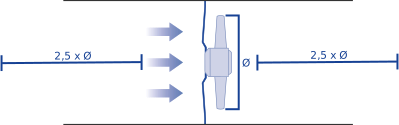
Important: To ensure optimum efficiency and acoustics of a duct fan, the inflow and outflow should be as linear and uniform as possible. Minimum distances from walls, elbows, or other obstacles within the duct system are recommended. Using the example of an axial duct fan, the recommended distance is 2.5 times the diameter (Ø) of the impeller.
 

Similarly, changing pipe diameters (if applicable) should be taken into account when designing the entire system and dimensioning the motor and aerodynamics (impeller). According to the continuity equation, there is a direct relationship between the cross-section of the air duct and the flow velocity in an unbranched system. The resulting effects on efficiency and acoustics should correspond to the specific requirements of the respective application.

Areas of application for duct fans

In general, duct fans are used wherever air or other gaseous media need to be conveyed, extracted, or supplied through a duct system. Some examples of applications in which fans can be integrated directly into a duct system are:

Which technical indicators are relevant?

Technical parameters such as volume flow, pressure increase, efficiency, power consumption, speed, and noise generation form the basis for the planning and design of all fan types. Especially in applications where the fan is used as an integral part of a closed system, the focus is on parameters that are affected by the corresponding system influences of the application:

  • Pressure increase: Pressure losses in the system (e.g., due to long/branched pipes, filters, frictional resistance, etc.) must be overcome.
  • System efficiency: In order to evaluate the efficiency or cost-effectiveness of a system, it is important to consider it as a whole, e.g., by taking into account transition losses at the inlet and outlet.
  • Characteristic curve behavior in the partial load range: The characteristic curve should be stable and controllable, without stall or overflow.
  • Sound pressure and sound power levels: In the pipe in which the fan is directly integrated, reflections and resonances can amplify the noise generated and transmit it throughout the entire system. In noise-sensitive applications, such as clean room workstations, it is particularly important that operation is as quiet as possible.
  • Pressure loss coefficient: Any losses that may occur due to the inlet and outlet geometry (e.g., tight pipe bends) must be taken into account when designing the system.
  • Temperature class and potentially explosive atmospheres: Especially for applications in potentially explosive atmospheres, additional factors must be taken into account in addition to the “classic” key figures, such as the reaction inertia of the fan material with the gases to be conveyed.
  • Speed control: For demand-oriented operation of the system, speed control can be carried out directly on the fan drive (EC technology) or by connecting a frequency converter (AC technology, standard motors).

How long does a duct fan last?

The lifetime of duct fans is directly related to the type of application and the amount of maintenance required.

Depending on the application, dust, moisture, grease, or other substances may accumulate in the pipes. The media compatibility of the materials used (e.g., temperature resistance, corrosion protection, chemical resistance, etc.) also has a direct impact on the service life and performance values of the entire system.

For optimal service life of the system, we recommend:

  • Take into account the exact requirements of the application when planning and designing the system (e.g., check material resistance).
  • Select suitable components (e.g., axial or radial fans, EC motors with speed control, communication modules, etc.).
  • Consider access points for maintenance and cleaning
  • Observe maintenance and cleaning intervals
  • Follow the manufacturer's installation instructions
  • Comply with safety requirements and applicable standards (e.g., DIN, ISO, VDI, etc.)
  • Continuous system monitoring during operation

Was this page helpful?