Country and language selection
Your country: Denmark
Your language: English
Do you want to switch to your country version? Welcome to ZIEHL-ABEGG!
You are visiting our Website from Greece?

On the website for your region you will find information on the products relevant to you, contact details and news.

Unfortunately, there is no Greek language version of our website. However, you can stay on this page or contact our sales representative in Greece directly.
What is torque?

Torque, also referred to as moment of force or rotational force, is a vectorial variable in physics that describes the effect of a force on the rotational movement of a rigid body around a certain point. 

Torque is measured and specified in newton meters (Nm)

In numerous applications such as electric motors, torque is crucial for the precise control of movements and efficient operation.

 Optimum torque for high-precision positioning: Ring motor SM985 & elevator drives from ZIEHL-ABEGG

Calculating torque

Torque (M) is the result of multiplying the lever arm (a) by the force (F) acting on it. Alternatively, the lever arm is also described in the torque formula with its radius (r).

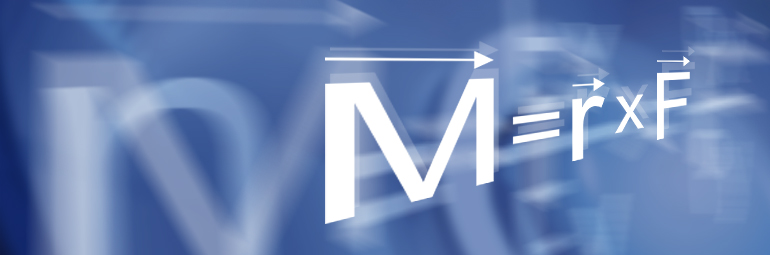
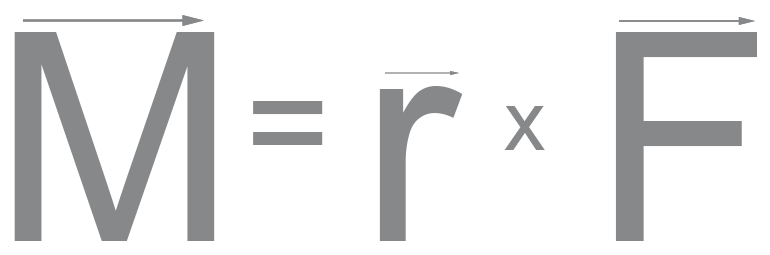
For the calculation, this results in the torque formula M = r x F.

Example: At a torque of 100 Nm, a force of 100 Newtons (N) acts on a lever arm of one metre (m): 100 Nm = 100 N x 1 m.

For use cases where the lever and the acting force are not perpendicular to each other, the torque only acts with the proportion of the force that is perpendicular to the lever (M = F x r x sinα ). 

The unit of measurement Newton meters (Nm), which is used to specify torque, is composed of the unit of the acting force in Newtons (N) and the unit of the lever in metres (m).

What does torque tell us?

Torque describes how strongly a certain force affects a rotating mounted body.
The torque of a body can be positive or negative, dependent on the direction of the force acting on it. 

Example: If one person is sitting on each side of a rocker, two different torques are acting, which generate movement in different directions.
If both forces act as a so-called force pair in mechanical equilibrium, the rotating body does not modify its state of motion. In this case, the body is both in equilibrium in force and equilibrium in torque.

How is torque generated in the electric motor?

In their basic design, electric motors always contain a moving rotor and a stationary stator. When the electric motor is put into operation, the rotor and stator create magnetic fields. The interaction between the two magnetic fields generates the torque in the air gap between the rotor and stator.

Torque and energy efficiency of electric motors

The torque of electric motors can affect their energy efficiency, especially when applications are exposed to variable loads and operating conditions. An electric motor that has been carefully designed for the required operating points has a positive effect on its energy efficiency. 

Modern electric motors are often combined with integrated or external control to maximise system efficiency and thus energy efficiency. 

The choice of an internal rotor or external rotor design also affects the torque: Due to the larger area of interaction between the rotor field and the magnetic field of the stator, external rotor motors generally achieve high torque with low energy consumption.

 Energy-efficient drive systems from ZIEHL-ABEGG for ventilation and drive technology

Utilisation of torque in electric motors

Torque is critical in various applications of electric motors. For the most efficient operation possible with the lowest possible vibration behaviour, the motor dimensioning and the achievable torque must be precisely matched to the respective load case. Examples:

 ZIEHL-ABEGG is happy to help you create the ideal design for your system. Please get in touch!

Was this page helpful?