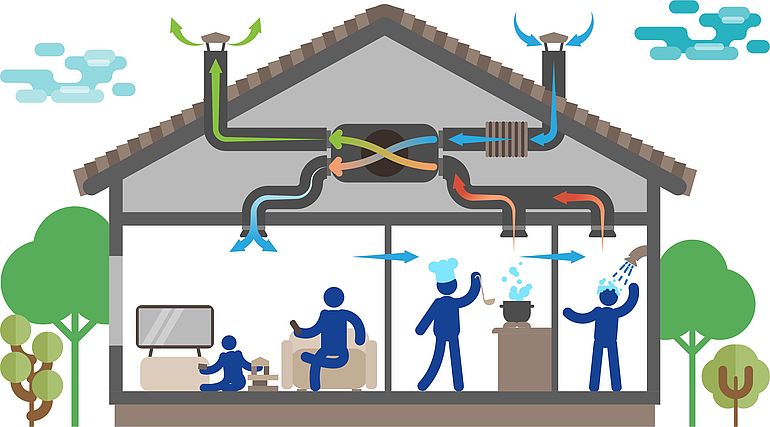
The higher the pressure loss (e.g., due to flow obstructions in the air duct, friction, or form resistance) in a system, the more energy is required by the fan to ensure the desired air delivery rate. From the user's point of view, it is therefore crucial to keep the pressure loss as low as possible for efficient operation.
Structural optimizations, such as the use of larger heat exchangers, shorter air ducts, or a larger pipe cross-section, can significantly reduce pressure loss. Although this increases the space requirements and, in some cases, the construction costs of the system, the system can be operated with significantly lower energy consumption. In addition, this leads to a reduced noise level. An optimized system configuration thus reduces operating costs over the entire service life of the system and usually leads to higher overall savings for the user.
Conclusion: In order to achieve the most efficient operation, optimal acoustics, and the highest cost-effectiveness of a system over its entire service life, numerous factors must be taken into account. Often, the best compromise between the given conditions and the ideal system design must be found from the user's point of view.
ZIEHL-ABEGG will be happy to assist you in designing your system for optimum performance. Contact us!